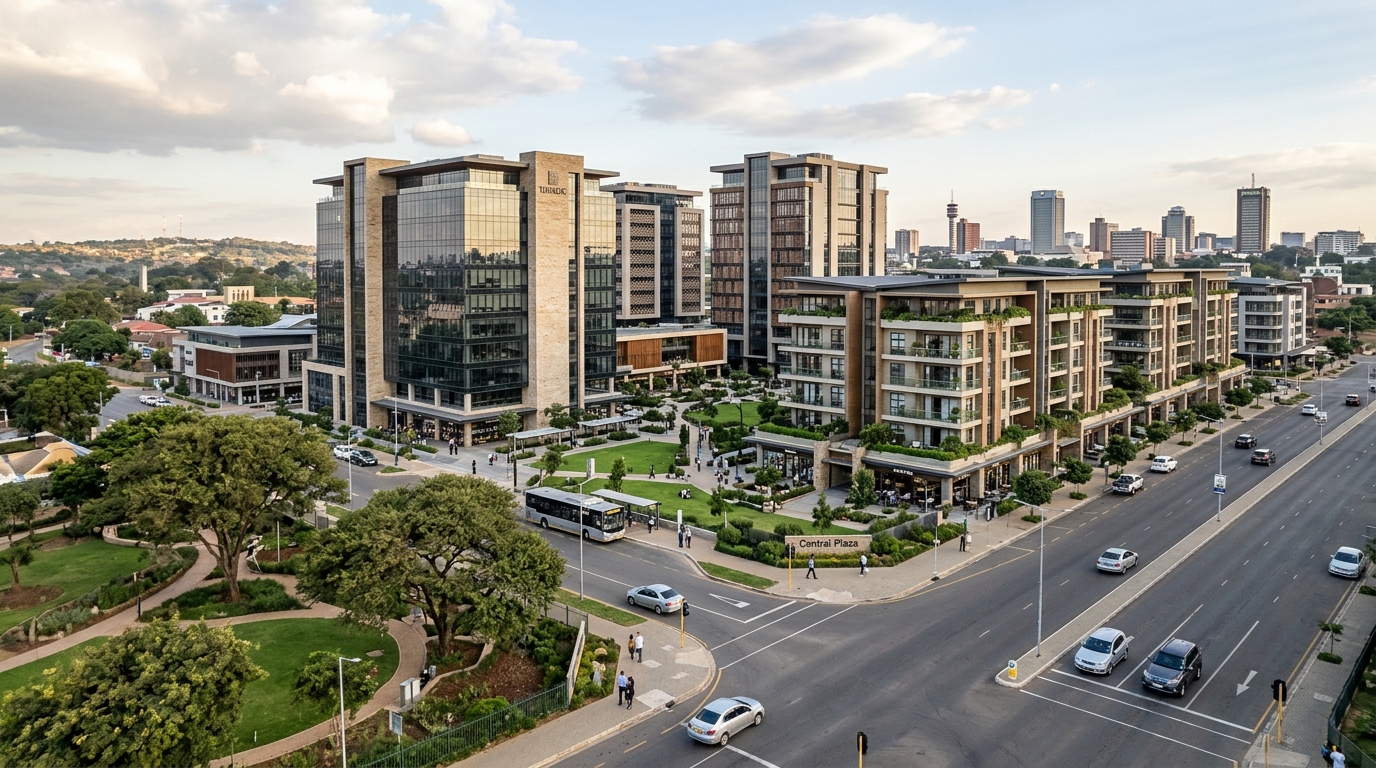
Zimbabwe’s property sector is experiencing a notable wave of investment, as local businesses, pension funds, wealthy individuals and institutional investors commit capital to residential and commercial developments.
From luxury apartments and gated communities in Harare’s northern suburbs to modern shopping centres and commercial buildings in smaller towns, the country’s built environment is undergoing a visible transformation.
The expansion reflects a changing investment landscape. Capital generated from mining, agriculture, retail, financial services and other productive activities is increasingly finding its way into real estate.
The shift is significant because property offers investors more than the prospect of capital appreciation. Well-positioned developments can generate rental income, support business activity, create employment and provide a physical asset that can preserve wealth over time.
Recent industry developments suggest that the investment cycle is also broadening beyond individual residential properties. Integrated precincts combining housing, retail, hospitality, healthcare and office space are becoming an increasingly important feature of the market.
However, the expansion should not be mistaken for uniform growth across the property sector. Demand varies considerably by location, property type and price category.
Local wealth is helping finance the expansion
One of the defining features of Zimbabwe’s current property investment cycle is the growing role of domestic capital.
Estate Agents Council of Zimbabwe chairperson Desire Dube has linked the expansion of commercial and residential developments to wealth generated through mining and agriculture.
He pointed to growing commercial activity in smaller centres such as Gwanda, Maphisa and Zvishavane. New commercial buildings, retail outlets and fuel service stations are emerging beyond the traditional investment centres of Harare and Bulawayo.
This suggests that property investment is increasingly following economic activity into secondary towns.
Mining has created opportunities for contractors, suppliers, transport operators and service providers. Agriculture has similarly generated wealth among commercial farmers, tobacco growers and businesses operating along agricultural value chains.
Some of this capital is being redirected into property development, particularly commercial buildings, shopping facilities, residential estates and hospitality projects.
The investment figures provide further context.
According to the Zimbabwe Investment and Development Agency’s 2024 annual report, real estate recorded the highest projected investment value among sectors, at approximately US$2.02 billion.
More recently, ZIDA’s first-quarter 2026 report showed total projected investment value across the economy rising 62% to approximately US$1.9 billion. Domestic direct investment increased from US$4.08 million to US$102.38 million during the period.
These figures point to increased local participation in investment activity. However, they cover different measures and periods. They should not be interpreted as proof that US$1.9 billion has already been invested in property. Investment commitments and projections are not the same as completed projects or capital actually deployed.
Institutional investors are entering the development space
A particularly important development is the growing participation of institutional investors.
Pension funds, insurance companies and investment managers are increasingly looking at property as a long-term asset class.
Their involvement can provide access to capital on a scale that individual developers may struggle to mobilise. It can also support professionally managed projects designed to generate recurring income.
The Public Service Pension Fund’s development in Eastlea, Harare, illustrates this approach.
The fund is developing a 10-hectare precinct incorporating high-rise residential apartments, retail facilities, a hospital, a five-star hotel, corporate offices and other amenities.
Civil works have been completed, while construction of the residential component is under way. The fund has also reported that retail brands are securing space ahead of completion.
The project represents a shift towards integrated property investment, where residential, commercial, medical and hospitality facilities operate within one development.
Old Mutual is also expanding its property investment activities.
In July 2026, Old Mutual Development REIT unveiled a US$46.2 million development pipeline spanning The Grange Lifestyle Estate in Harare and a hospitality project in Victoria Falls.
The pipeline illustrates how institutional capital can be channelled into different property segments, including residential, commercial and tourism-related assets.
The growing use of Real Estate Investment Trusts (REITs) is another development worth watching.
REITs allow investors to gain exposure to property assets through structured investment vehicles rather than having to purchase entire buildings or developments themselves.
For Zimbabwe’s capital markets, this creates an opportunity to broaden investment participation and channel savings into productive physical assets.
However, the long-term success of these vehicles will depend on transparent valuations, credible asset management, sound governance and the ability of underlying properties to generate sustainable income.
Harare’s premium property market continues to evolve
Harare remains the centre of Zimbabwe’s high-value property market.
The northern suburbs, particularly Borrowdale, Glen Lorne, Mount Pleasant and surrounding areas, continue to attract developers targeting affluent buyers and tenants.
Gated residential communities, apartment complexes and lifestyle estates are increasingly competing on more than location and architectural design.
Modern developments are incorporating security systems, solar power, water storage, recreational facilities and shared amenities.
These features respond to practical concerns facing property owners and tenants, particularly the need for reliable utilities and secure living environments.
One example is the 2 267 Lifestyle Estate in Glen Lorne, a reported US$16 million development comprising 82 apartments.
The project incorporates residential facilities, recreational amenities and solar-fed inverters intended to reduce exposure to electricity interruptions.
Another major development is the Highland Park Precinct along ED Mnangagwa Road.
The project is being expanded into a large mixed-use development combining residential, retail, office, hospitality and conference facilities.
Its development illustrates the increasing importance of property ecosystems rather than isolated buildings.
A significant addition to the precinct is the planned 140-room Hilton Garden Inn, following an agreement between Hilton and Terrace Africa. The hotel is expected to open in early 2029.
This will be Hilton’s first hotel in Zimbabwe and could strengthen the commercial appeal of the surrounding development by attracting business travellers, conferences and tourism-related activity.
The wider opportunity extends to restaurants, transport operators, retailers, professional services and serviced accommodation providers.
However, the presence of a prestigious development does not automatically guarantee higher returns for every surrounding property. Actual demand, rental levels and occupancy remain decisive.
Commercial property is moving towards mixed-use and suburban developments
The commercial property market is also undergoing a structural adjustment.
Traditional office buildings in central business districts are facing pressure from changing business requirements, ageing infrastructure, congestion and the decentralisation of corporate activity.
Knight Frank’s H2 2025 Africa Offices Market Dashboard estimated office vacancy rates at approximately 60% in Harare’s CBD and 40% in Bulawayo.
The report also noted that Harare’s suburban office locations were outperforming central business district properties.
Average prime rents were estimated at US$10–12 per square metre per month in suburban Harare, compared with US$5–8 in the CBD. Average yields were estimated at 9% and 7%, respectively.
The figures underline an important shift: businesses are increasingly interested in offices that offer reliable utilities, security, parking, connectivity and more efficient working environments.
New purpose-built facilities developed by financial institutions, including Afreximbank, Stanbic Bank, First Capital Bank, Ecobank and CBZ Bank, demonstrate the demand for modern corporate infrastructure.
At the same time, property owners are reconsidering the future of older buildings.
Some are subdividing large office floors into smaller units, while others are exploring residential conversions, serviced offices and mixed-use developments.
First Mutual Properties has reported that CBD office vacancies in the 40–60% range are encouraging owners to reposition space for smaller businesses and start-ups.
This presents an opportunity for property owners to serve SMEs that cannot afford large corporate offices but need professional business premises.
The commercial market is therefore not simply expanding. It is changing in response to how businesses operate and where customers spend money.
Investment is spreading beyond Harare
Perhaps one of the more significant developments is the increasing attention being given to smaller towns and emerging growth centres.
Gwanda, Maphisa, Zvishavane, Bindura and Mazowe are among the locations attracting new commercial investment.
Retail outlets, fuel stations, shopping facilities and modern commercial buildings are following population growth, mining activity, agricultural production and improved road connectivity.
Mazowe provides an example of how infrastructure can influence property development.
The completion of the first phase of Mazowe Walk Shopping Mall has introduced modern retail facilities and a fuel station to the area.
The development is complemented by other investment in tourism and hospitality, including the Baradzanwa luxury resort project.
Further south, WestProp Holdings unveiled its Chivhu Eco City development in April 2026.
The proposed 5,000-hectare project is expected to deliver approximately 20,000 residential properties. Its initial phase includes 2,400 stands, with the developer announcing mortgage terms of up to 30 years for qualifying buyers.
The project is designed around an integrated live-work-shop-and-play model, with the intention of developing Chivhu as a residential and investment centre.
Such projects could help redirect some urban growth away from established cities.
But their success will depend on more than the availability of land. Roads, water, electricity, sanitation, schools, healthcare and employment opportunities must develop alongside residential settlements.
Without these services, new developments risk becoming disconnected residential enclaves rather than sustainable economic centres.
Diaspora capital remains an important source of demand
The Zimbabwean diaspora continues to play an important role in the property market.
Property has long been attractive to Zimbabweans living abroad who want to secure homes, establish retirement assets or maintain a financial connection with the domestic economy.
The Reserve Bank of Zimbabwe reported that diaspora remittances reached approximately US$2.45 billion in 2025, up from US$2.15 billion in 2024.
These inflows represent an important source of foreign currency and household purchasing power. A portion supports residential construction, property purchases and home improvements.
The influence of diaspora investment is also reflected in the premium residential market.
Developers increasingly target overseas Zimbabweans through structured payment arrangements, property showcases and investment marketing.
However, remittances should not be confused with property investment. Much of the money sent home supports household consumption, education, healthcare and other family needs.
The opportunity for the property sector lies in developing credible investment structures that allow diaspora funds to participate in properly documented, professionally managed projects.
Secure title, transparent pricing, reliable construction progress and independent verification are essential to building investor confidence.
The affordability gap remains a major concern
While premium developments attract attention, Zimbabwe’s housing challenge remains much larger than the luxury market.
The country’s need for affordable housing, serviced stands and supporting infrastructure remains substantial.
The National Development Strategy 2 (NDS2), covering 2026–2030, sets a target of delivering one million houses and serviced stands across rural and urban areas.
Government estimates that more than US$15 billion will be required, through a combination of public resources and private sector-led initiatives.
The strategy also identifies low-income housing, mortgage guarantees, housing funds and partnerships with pension and insurance institutions as important areas of intervention.
This creates a significant opportunity for developers to expand beyond the premium market.
There is potential for professionally designed medium-density housing, serviced residential stands, affordable apartments and rental accommodation.
The commercial case is also compelling.
A development that serves a broader market can generate demand from a larger customer base, provided pricing reflects household incomes and financing conditions.
However, affordability remains constrained by high construction costs, limited access to long-term mortgages and the cost of servicing land.
Mashonaland Holdings, reporting on the first half of 2026, highlighted these pressures. The company noted that demand was increasingly concentrated in well-located, affordable and flexible properties.
It also reported that residential demand remained positive for serviced stands and cluster housing, while limited mortgage finance continued to constrain transactions.
The market therefore needs a stronger balance between premium developments and housing that ordinary working households can afford.
Infrastructure and regulatory discipline will determine the next phase
Zimbabwe’s property expansion will increasingly depend on the quality of the country’s urban infrastructure and planning systems.
Developers need serviced land, reliable electricity, water, sewerage systems and accessible roads.
These are not secondary considerations. They directly affect construction costs, occupancy, property values and the ability to attract tenants.
The pressure is particularly visible in fast-growing suburban areas where residential clusters and commercial developments are expanding faster than supporting infrastructure.
The Tigere Property Fund’s 2025 market assessment highlighted the pressure that intensive residential construction can place on water, sewerage, electricity and other services in suburban locations.
Land governance is equally important.
Investors and prospective property owners need confidence that developments have valid title, approved layouts, appropriate permits and compliance with local authority requirements.
The risks associated with disputed land allocations and unauthorised construction can undermine confidence across the entire sector.
A credible property market requires predictable planning approvals, transparent land administration and effective enforcement of building standards.
For institutional investors, these considerations are particularly important because projects involve substantial capital commitments and long investment horizons.
Business Diary Analysis
The real estate opportunity is shifting from property ownership to productive assets
Zimbabwe’s property investment cycle is revealing an important change in the country’s domestic capital market.
Property is becoming an increasingly important destination for wealth generated in other sectors.
Mining, agriculture, financial services, retail and diaspora-linked capital are helping finance developments that can generate income over extended periods.
The involvement of pension funds and REITs is particularly significant. It creates opportunities to mobilise long-term savings and direct them towards professionally managed property assets.
However, the quality of investment matters more than the number of buildings under construction.
A shopping centre must attract tenants. An office building must meet the needs of businesses. A residential estate must serve a market that can afford its units. A hotel must attract sufficient visitors to sustain operating costs.
The high vacancy levels in central business districts demonstrate what happens when property supply, location and tenant demand become disconnected.
The next phase of Zimbabwe’s property market will therefore reward developers who understand market demand, manage construction costs and deliver functional infrastructure.
There are also important opportunities for local businesses.
Construction companies, engineering firms, manufacturers, furniture suppliers, security providers, cleaning companies, property managers, landscapers and technology providers can participate in the expanding development value chain.
For SMEs, the opportunity extends beyond construction contracts. New commercial precincts create demand for restaurants, retail outlets, maintenance services, professional services and other businesses.
The sector can therefore contribute to employment and enterprise development well beyond the property companies themselves.
The strategic opportunity is to turn property investment into wider economic activity, rather than simply adding more premium buildings to the urban landscape.
Key Takeaways
-
Domestic capital is becoming more visible: Mining, agriculture, institutional funds and private investors are supporting new property developments.
-
Mixed-use projects are gaining importance: Developers are combining residential, commercial, retail, hospitality and lifestyle facilities.
-
Location and tenant demand matter: Suburban commercial properties are outperforming many traditional CBD office assets.
-
The affordable housing gap remains substantial: Premium developments alone cannot address Zimbabwe’s wider housing requirements.
-
Infrastructure and governance are critical: Secure land rights, reliable utilities and proper planning will determine the sustainability of future developments.
What’s Next?
The property sector’s next growth phase will depend on its ability to convert investment interest into completed, occupied and income-generating assets.
Three developments deserve close attention.
First, institutional investors and REITs could become more important sources of long-term development finance. Their performance will depend on transparency, sound governance and reliable rental income.
Second, secondary towns could attract more commercial and residential investment as infrastructure improves and economic activity becomes more geographically distributed.
Third, affordable and medium-density housing could become a more important market as developers respond to the gap between premium property prices and household purchasing power.
The long-term test will be whether Zimbabwe can build a property market that creates investment returns while supporting productive businesses, sustainable urban growth and wider access to decent housing.