


Connect with us

Technology & Telecommunications

China’s 19-Seat Electric Aircraft Completes First Crewed Flight, Targets Regional Aviation Market

The COMAC-developed CE-25A has a stated range of 400 kilometres and a cruising speed of 300km/h. Its first piloted flight moves the programme closer to certification, but commercial operations remain some distance away.

Published

on

China’s 19 Seat Electric Aircraft Completes First Crewed Flight, Targets Regional Aviation Market

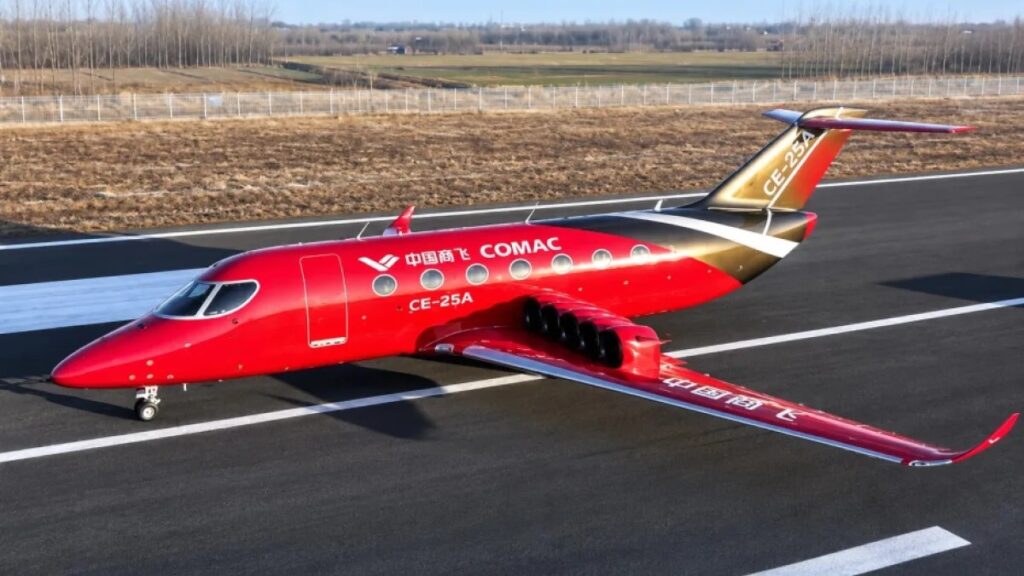
China has completed the first piloted flight of its CE-25A electric commercial aircraft, marking a new stage in the country’s efforts to develop battery-powered passenger aviation.

The aircraft, developed by the state-owned Commercial Aircraft Corporation of China (COMAC) with domestic partners, flew on 14 November in Binzhou, Shandong Province. It carried two pilots and a flight-test engineer.

COMAC reported that the aircraft operated normally and that its performance indicators met expectations. The flight followed an earlier phase of autonomous testing, which began with an uncrewed flight on 2 February 2026.

The CE-25A is designed primarily for short intercity journeys. It can accommodate up to 19 passengers and has a maximum take-off weight of 10 tonnes.

China’s 19-Seat Electric Aircraft Completes First Crewed Flight, Targets Regional Aviation Market

China’s 19-Seat Electric Aircraft Completes First Crewed Flight, Targets Regional Aviation Market

The development is significant because it takes electric aviation into a larger passenger-aircraft category. Most electric aircraft projects have concentrated on smaller training aircraft, drones and vertical take-off and landing vehicles.

However, the CE-25A remains a development aircraft. It must complete the required testing and obtain regulatory approval before it can carry paying passengers.

Key specifications

COMAC’s published specifications place the aircraft in the short-range regional transport market.

Specification Published figure
Aircraft

CE-25A

Developer

COMAC and partners

Passenger capacity

19

Maximum take-off weight

10 tonnes

Cruising speed

300 km/h

Stated range

400 km

Cruising altitude

2,400 metres

Propulsion

Distributed electric ducted-fan system

Intended market

Intercity commercial flights

The aircraft uses multiple electrically driven fans distributed along the wings. This configuration differs from conventional aircraft that rely on conventional jet or turboprop engines.

Its development involved COMAC, battery manufacturer Contemporary Amperex Technology Co. Limited (CATL), Shanghai Jiao Tong University and other partners.

The partnership brings together aircraft manufacturing, battery technology and academic engineering expertise. Battery performance is particularly important because it affects an electric aircraft’s range, payload, operating costs and ability to complete repeated flights.

First piloted flight follows autonomous testing

The November flight followed the aircraft’s first autonomous, uncrewed flight in February.

COMAC has completed 19 unmanned autonomous flight validations, according to the Civil Aviation Administration of China (CAAC). The first piloted flight was therefore a further milestone in the programme’s testing sequence, rather than the beginning of its development.

City News Service reported that the aircraft covered 60.4 kilometres and spent just under 17 minutes in the air during the piloted test. That distance is considerably shorter than its stated 400-kilometre design range. The test should not be interpreted as proof that the aircraft has already demonstrated its full advertised range.

The CAAC has accepted COMAC’s application for a type certificate. Acceptance of the application is an important regulatory step, but it does not mean the aircraft has been certified or cleared for commercial passenger operations.

The certification process includes technical documentation reviews, witnessed testing and certification flight tests.

Future prospects

The CE-25A’s commercial prospects will depend on whether its technical performance can translate into a reliable and economically viable passenger service.

Its stated 400-kilometre range points towards short regional and intercity routes. Such aircraft could eventually serve connections between smaller cities, regional centres and airports that do not support larger passenger aircraft.

China’s 19-Seat Electric Aircraft Completes First Crewed Flight, Targets Regional Aviation Market

China’s 19-Seat Electric Aircraft Completes First Crewed Flight, Targets Regional Aviation Market

For operators, the attraction would be the potential to reduce dependence on conventional aviation fuel. Electric propulsion could also offer lower noise and fewer direct operational emissions than conventional combustion engines.

These advantages, however, are not automatic guarantees of lower overall operating costs. Airlines and operators would still need to account for aircraft acquisition, battery replacement, electricity supply, charging infrastructure, maintenance, insurance and regulatory compliance.

The aircraft’s 19-seat capacity also creates a specific commercial challenge. Operators would need sufficient passenger demand and suitable fares to make regular services financially sustainable.

Battery technology remains central

Battery performance will be one of the decisive factors in the aircraft’s future.

Unlike conventional aircraft, which can replenish energy through established aviation-fuel infrastructure, electric aircraft require suitable charging systems and access to sufficient electrical capacity.

Operators will also need to manage battery degradation, charging time, operating reserves and performance under different weather and temperature conditions.

These considerations will determine how frequently the CE-25A can fly, how far it can operate under real-world conditions and how much payload it can carry while maintaining safe reserves.

Certification will determine the commercial timetable

The CE-25A must progress from experimental testing to full regulatory approval.

Certification will require evidence that its structure, propulsion systems, electrical architecture, flight controls and safety systems meet applicable airworthiness requirements.

The aircraft’s designation references China’s CCAR-25 transport-aircraft airworthiness framework, according to City News Service. The acceptance of its type-certificate application does not establish that the aircraft has already met all certification requirements.

The timeline for certification, production and entry into commercial service has not been confirmed in the available announcements.

What the development means for Africa and Zimbabwe

China’s electric-aircraft programme is worth watching in Africa, where many countries face the challenge of connecting smaller cities, regional economic centres and remote communities.

In principle, a 19-seat aircraft could be relevant to selected short routes, including tourism, business travel and regional connectivity. However, the CE-25A’s suitability for African markets will depend on its eventual certification, actual operating range, acquisition cost, charging requirements and local aviation infrastructure.

For Zimbabwe, potential applications could include connections between Harare, Bulawayo, Victoria Falls and other regional destinations. But these are prospective route possibilities, not announced plans or evidence that the aircraft is ready for local deployment.

Zimbabwe would also need to assess airport infrastructure, electricity reliability, charging capacity, maintenance capability and the regulatory requirements for introducing electric passenger aircraft.

The broader opportunity may extend beyond aircraft operations. Electric aviation could create demand for specialist engineering, battery systems, charging infrastructure, maintenance services and aviation training.

For African policymakers and investors, the development highlights the importance of preparing for changes in aviation technology without assuming that emerging aircraft will immediately be commercially viable.

A developing aviation market

COMAC’s CE-25A adds to China’s wider effort to build domestic capability across the aviation value chain.

The company is already developing and manufacturing conventional commercial aircraft, including the C909 regional jet and C919 single-aisle passenger aircraft. The CE-25A represents a different technological direction, focused on electric propulsion and shorter-distance transport.

Its success will depend on more than the ability to fly. It must demonstrate safety, reliability, useful operating range and competitive economics.

The first piloted flight is an important milestone. The more consequential test will be whether COMAC can turn the prototype into a certified aircraft that airlines and passengers can depend on.

Business Diary Analysis

The CE-25A is significant because it represents an attempt to scale electric aviation beyond small aircraft and experimental air taxis.

Its 19-seat configuration targets a potentially useful segment between small private aircraft and larger regional jets. This could open opportunities for operators serving routes with limited passenger volumes.

However, the 400km stated range remains a critical commercial constraint. Real-world operating range must account for passenger and baggage loads, weather, reserves, charging requirements and airport infrastructure.

The commercial question is whether electric propulsion can deliver sufficient cost savings to offset the investment required in batteries, aircraft technology and charging facilities.

For Zimbabwe and the wider African market, the technology merits attention, particularly as countries consider regional aviation, tourism connectivity and transport infrastructure investment. But local adoption should be based on demonstrated operating economics rather than the novelty of electric flight.

What’s next?

The key developments to watch are:

  1. Progress towards type certification by China’s aviation regulator.
  2. Further piloted and certification flight tests.
  3. Independent evidence of actual range, payload and battery performance.
  4. Production plans and potential airline or operator partnerships.
  5. Commercial pricing and the infrastructure required to support regular operations.

The Business Diary magazine is a comprehensive publication that centers around business and economic development news. It covers a wide range of topics including finance, mining, technology, environment, climate finance, and agriculture. With its focus on providing valuable insights and updates, the magazine caters to readers who are interested in staying informed about the latest developments and trends in the business and economic landscape of Zimbabwe.

Continue Reading

Technology & Telecommunications

Cassava Technologies taps Graphiant to secure African networks as US$720m Nvidia GPU rollout advances

Cassava Technologies, the group founded by Zimbabwean businessman Strive Masiyiwa, has partnered with US networking firm Graphiant to offer security-focused network services across Africa. The deal supports a plan to deploy 12,000 Nvidia GPUs across five countries at a cost of up to US$720 million.

Published

on

Cassava Technologies taps Graphiant to secure African networks as US$720m Nvidia GPU rollout advances

HARARE – Cassava Technologies has partnered with Silicon Valley networking company Graphiant to secure its African networks. The deal comes as Cassava builds out what it calls Africa’s first AI factory, a plan to deploy 12,000 Nvidia graphics processing units (GPUs) across five countries at a cost of up to US$720 million.

The partnership is run through Liquid C2, Cassava’s cloud and security business. It covers a “quantum secure network-as-a-service”. As reported by Business Insider Africa, the service would let customers choose the countries their traffic passes through, encrypt that traffic and keep an auditable record of the route. Network-level policies would limit which destinations AI agents can reach, and session tracing and segmentation would help contain compromised agents or devices. Graphiant says it can migrate customers to new encryption algorithms as post-quantum standards evolve. The first rollout is planned for South Africa in the first half of 2027, with other markets to follow as demand develops.

Background

Cassava first announced the AI factory plan in early 2025 with Nvidia, which later took an equity stake of undisclosed size. The company said it would install GPUs in South Africa, Nigeria, Kenya, Egypt and Morocco. The first phase is 3,000 GPUs in South Africa, with a further 9,000 planned across the other four countries over three to four years.

Masiyiwa said in late 2025 that Cassava had acquired the 12,000 GPUs, shipped in about 28 containers. The company launched what it described as Africa’s first GPU-as-a-service and said it was already onboarding customers. This month, a Cassava executive told Business Insider Africa the aspiration is to deploy 12,000 to 13,000 GPUs across the continent.

The US$720 million is a ceiling, not a committed spend. Reports do not show how it is split between chips, buildings, power and networking. Cassava’s President and CEO Hardy Pemhiwa has said the investment is about building the whole AI ecosystem, not just the hardware. Cassava owns Liquid Intelligent Technologies, which operates more than 110,000 kilometres of fibre across Africa, along with Africa Data Centres and Liquid C2. Nvidia and Google are both shareholders.

Business Diary Analysis

The Graphiant deal addresses a gap that hardware alone does not fill. GPU clusters are only useful if customers can reach them over secure, reliable links, and businesses handling sensitive data want control over where their traffic travels. Cassava is linking its fibre and cloud assets to the GPU capacity, and the security layer is part of that.

For Zimbabwe, the effect is indirect. Zimbabwe is not among the five sites, so local firms would reach the capacity through cloud services and network links. The practical questions are then connectivity, pricing and whether the data-location controls meet local requirements. The venture is led by a Zimbabwean founder, but the GPUs are not in Zimbabwe.

Execution risks remain. Dense GPU clusters need steady, high-capacity power and cooling, and grid reliability is a concern across the target markets. Revenue will depend on whether African start-ups, researchers and governments buy the capacity in volume.

What’s next?

South Africa is the first market for the secure network service, in the first half of 2027. Cassava has not published a timeline for the other four countries.

Continue Reading

Technology & Telecommunications

Liquid C2 partners with Google Cloud and Anthropic to bring advanced cloud, cyber security and generative AI capabilities to Africa

Published

on

Liquid C2 partners with Google Cloud and Anthropic to bring advanced cloud, cyber security and generative AI capabilities to Africa

Liquid C2, a business of Cassava Technologies, a pan-African technology group, today announced collaborations with global technology leader Google Cloud and artificial intelligence (AI) company Anthropic to deliver advanced cloud, cyber security solutions, and generative AI (gen AI) capabilities to African businesses across the continent.

Building on the November 2023 signature of a Memorandum of Understanding (MOU) for a collaboration with Google Cloud in Africa, Liquid C2 is set to improve cyber security and cloud offerings across the continent while introducing them to Google Cloud’s latest AI, data, collaboration, and security solutions. Customers of Liquid C2 can expect heightened security measures, access to advanced cloud technologies, and a commitment to securing their digital assets.

Liquid C2 is set to be one of Google Cloud’s largest Managed Security Service Providers (MSSPs) in Africa, combining Google Cloud’s leading security solutions with Liquid C2’s expertise and vision in offering comprehensive security consulting. In addition, the collaboration enables Liquid C2 to bring the capabilities of both Google Cloud and Anthropic’s AI models to its customers via Google Cloud’s Vertex AI platform1, helping businesses develop and deploy solutions quickly within their cloud environments.

As a strategic partner of Google Cloud’s innovative solutions in Africa, Liquid C2 will also deliver Google Workspace to customers across the continent. Designed to facilitate team connections in a cloud-native environment, Google Workspace also features embedded generative AI tools to help employees create content and achieve greater productivity and collaboration in the workplace.

By fortifying cyber security measures and infusing gen AI capabilities, Liquid C2 envisions a future where security, collaboration, and innovation go hand-in-hand, creating a safer, more productive digital experience for all. As Africa continues to emerge as a hub for technological advancements, collaboration between leading companies like Liquid C2, Google Cloud, and Anthropic play a crucial role in driving progress, fostering innovation, and attracting global investment.

In a separate but related development, Liquid C2 is also working directly with Anthropic, one of the largest and fastest-growing AI companies globally, to develop AI solutions for large enterprises that want to use it to improve productivity and revenue growth. Anthropic has a strategic partnership with Google Cloud, and Claude – Anthropic’s family of foundational AI models that excel at thoughtful dialogue, content creation, complex reasoning, creativity, and coding – is available in Google Cloud’s Vertex AI.

Liquid C2’s partnership with Anthropic signifies a shared commitment to empowering businesses in Africa with state-of-the-art AI solutions. By integrating AI models and services across various industries, Liquid C2 and Anthropic aim to accelerate growth for clients, further positioning Africa as a global player in the digital landscape. The collaboration presents opportunities to apply gen AI to African businesses irrespective of the industry or organisation size.

Thomas Kurian, CEO of Google Cloud said, “Businesses are increasingly turning to generative AI to drive operational efficiencies, improve the customer experience, and empower their employees like never before. Building on Google’s commitment to investing $1 billion to boost Africa’s digital transformation, our collaborations with market leaders like Liquid C2 and Anthropic will help bring gen AI, security, and other cloud technologies to businesses across the continent. This partnership has the opportunity to transform how African businesses serve and engage their customers as we provide them a foundation for innovation.”

Currently, more than 80% of the largest businesses and organisations operating in more than      31 African countries use a broad spectrum of advanced digital technologies from Liquid supplied by global vendors. Many are keenly interested in moving AI readiness. Liquid C2 will remain a multi-vendor provider, offering its customers best-in-class solutions.

Commenting on the collaboration, Strive Masiyiwa, Co-Founder and Executive Chairman of Cassava Technologies, said, “Our collaborations with Google Cloud and Anthropic signify a significant step change in our journey as Africa’s leading cloud and cyber security provider.      We recognise the importance of responsible AI in enabling access to economic opportunities and empowering individuals and businesses across the continent. Our partnerships with these two leading technology firms will help us deliver      AI-powered solutions that address the unique challenges and opportunities in      Africa’s digital transformation journey. Together, we are setting new benchmarks for these solutions that cater to the complex needs of a diverse clientele.”

Daniela Amodei, President of Anthropic, said: “We’re excited to partner with Liquid C2 and Google Cloud, bringing frontier AI to businesses across Africa. Combining Anthropic’s safe, steerable AI with Google Cloud’s secure, scalable infrastructure means this partnership has huge potential to enable African companies to grow.”

Continue Reading

Trending

×