Connect with us

Business & Economy

Zimbabwe to host AfCFTA trade ministers on 28 November as officials open preparatory talks

Harare will host the 19th Council of Ministers Responsible for Trade on 28 November, with senior officials and services negotiators already at work. The meeting puts Zimbabwe at the centre of continental efforts to move the African Continental Free Trade Area from negotiation to implementation.

Published

on

Zimbabwe to host AfCFTA trade ministers on 28 November as officials open preparatory talks

HARARE – Zimbabwe will host the 19th Meeting of the African Continental Free Trade Area (AfCFTA) Council of Ministers Responsible for Trade on 28 November 2026 at the New Parliament Building in Mount Hampden, the foreign affairs ministry has announced.

Preparatory work has begun. The 19th Meeting of the Committee on Trade in Services began in Harare on 16 November and runs through the following week. Its outcomes will feed into the 23rd Meeting of the Committee of Senior Trade Officials on 24 November, where recommendations will be consolidated for ministers. A Regional Economic Communities Co-ordination Meeting follows on 29 and 30 November to align regional blocs on the continental trade agenda.

The ministry has not published the ministers’ agenda, and no outcome documents are available. The meeting was reported as an effort to accelerate implementation of the AfCFTA and deepen regional integration.

One agreement may be signed on the sidelines. Nigeria’s Trade and Investment Minister, Jumoke Oduwole, told Reuters that a digital-trade agreement bringing together Nigeria, Kenya, Ghana, Rwanda, South Africa and Egypt is expected to be signed during the Zimbabwe meeting. That signing has not been confirmed by the host or the AfCFTA Secretariat.

Background

Ministers endorsed Zimbabwe as host at the 18th Council meeting in Abuja, which concluded in early July. The AfCFTA Secretariat said the focus there shifted decisively from negotiating rules to making them work, with the legal architecture now substantially in place. One annex to the Protocol on Intellectual Property Rights remains to be finalised. The Council also adopted an Agri-trade Action Plan aimed at agro-industrialisation and food security.

Reporting at the time quoted Foreign Affairs and International Trade Minister Amon Murwira as saying the 19th meeting would be held in Victoria Falls in 2027, alongside Zimbabwe hosting the 2029 Intra-African Trade Fair. The ministry’s current notice instead gives 28 November 2026 in Harare. The change of date and venue has not been explained in the reports reviewed.

The African Union Assembly directed ministers in February 2026 to open negotiations on a Protocol on Industrial Policy and Development. Zimbabwe is also due to host the headquarters of the Intra-African Trade Fair Company in Harare, which Finance Minister Mthuli Ncube linked to trade, investment and infrastructure gains in the 2026 Budget.

Business Diary Analysis

For Zimbabwean business, the practical value of these meetings lies in what ministers adopt and how quickly it reaches the border. The AfCFTA’s legal texts are largely in place, but implementation has proceeded unevenly across the continent, and a 2026 academic study questions whether Zimbabwe can move beyond policy design to fix the implementation failures that have long limited its trade competitiveness. Without domestic reforms, the study warns, liberalisation could raise import penetration instead of strengthening local production.

The services committee’s presence is a signal. Services is the area where most Zimbabwean professional firms, banks and technology businesses would seek regional market access, and negotiations there have lagged those on goods.

Hosting gives Zimbabwe agenda influence and visibility, but it does not bring commitments by itself. Officials in a ZIMRA release in July tied regional customs digitalisation to lower costs of doing business and better border efficiency, and that is the sort of outcome exporters will measure.

What’s next

Senior officials meet on 24 November, ministers on 28 November, and the regional economic communities on 29 and 30 November. Business should watch for the ministers’ communiqué, any decisions on trade in services, progress on the intellectual property annex and the industrial policy protocol, and whether the digital-trade agreement is signed. The measure of the week will be whether decisions reach exporters and importers at the border.

The Business Diary magazine is a comprehensive publication that centers around business and economic development news. It covers a wide range of topics including finance, mining, technology, environment, climate finance, and agriculture. With its focus on providing valuable insights and updates, the magazine caters to readers who are interested in staying informed about the latest developments and trends in the business and economic landscape of Zimbabwe.

Business & Economy

Simbisa Revenue Climbs 20% to US$367.2m as Profit After Tax Reaches US$24.1m

Zimbabwe’s contribution to group revenue remained dominant, accounting for 72% of sales, as the fast-food operator benefited from higher customer volumes, stronger spending and regional growth. However, rising operating costs and taxation remain important risks as the group enters FY2027.

Published

on

Simbisa Brands lifts full-year profit 43% to US$24.1m as Zimbabwe drives 20% revenue growth

HARARE – Simbisa Brands Limited increased revenue by 20% to US$367.2 million in the financial year ended 30 June 2026, supported by higher customer traffic and increased average spending across its markets.

The Zimbabwe Stock Exchange-listed group’s profit after tax rose to US$24.1 million from US$16.9 million in the previous financial year. Profit before tax increased 36% to US$31.9 million, while headline earnings per share advanced 45% to 4.33 US cents from 2.98 US cents.

Operating profit before impairment, depreciation and amortisation increased 28% to US$58.1 million, compared with US$45.4 million in FY2025.

The audited results, released on 29 September, show that customer volumes increased 11% during the year, while average spend grew 8%. Cash generated from operations rose 27% to approximately US$65.2 million, representing a 112% operating-profit-to-cash conversion rate.

The board declared a final dividend of 0.622 US cents per share, bringing the total dividend for the financial year to 1.556 US cents. This includes the interim dividend of 0.934 US cents.

Zimbabwe remains the group’s largest market

Zimbabwe continued to anchor Simbisa’s regional operations, contributing 72% of group revenue.

Revenue in the local market increased 23%, while customer numbers reached a record 53.6 million, representing an 11% increase from the previous year. Operating profit rose 39%.

The performance came despite higher employee costs, energy expenses, intermittent electricity supply challenges and the introduction of the Fast-Food Tax.

Simbisa disclosed that it paid US$2.1 million in Fast-Food Tax during FY2026. The company said procurement savings, productivity improvements and tighter expenditure controls helped absorb some of the additional costs.

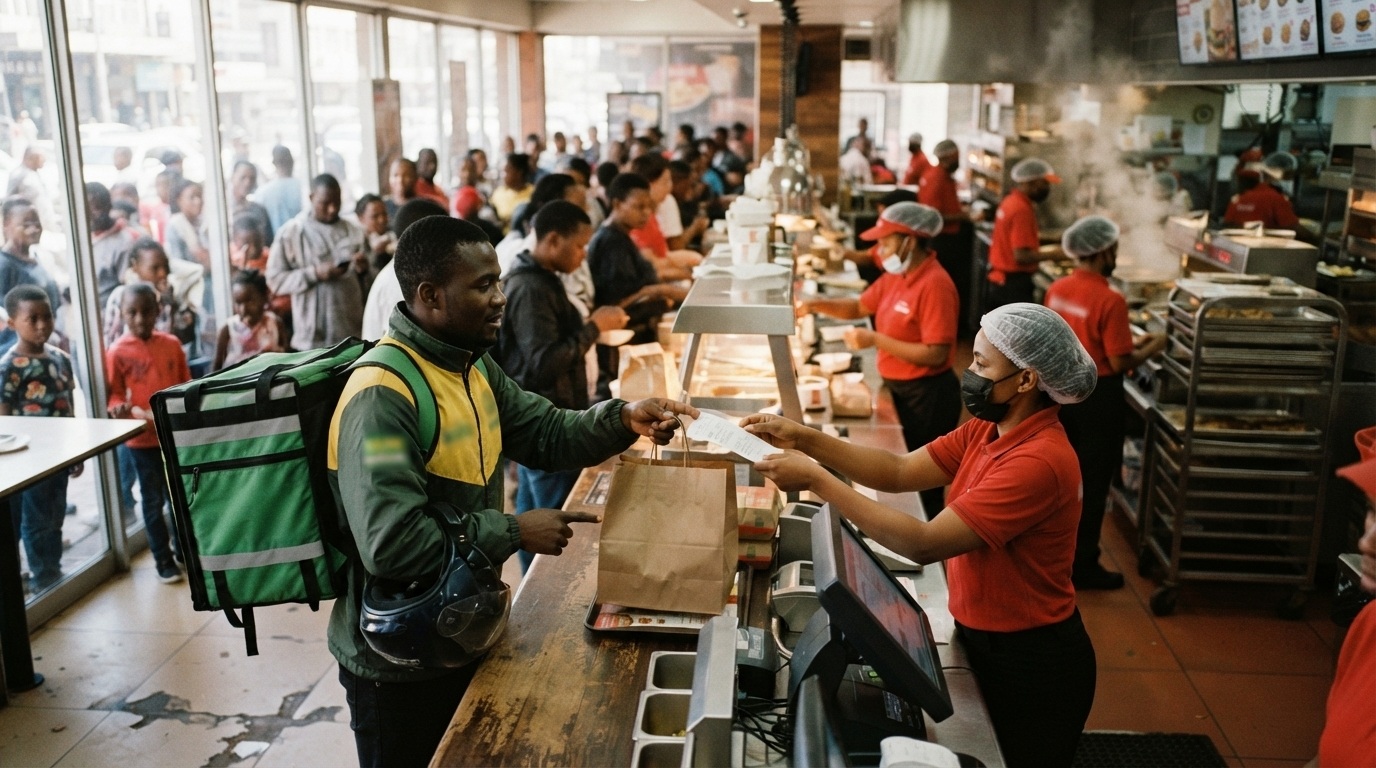
Delivery was another important growth driver. Orders in Zimbabwe increased 75% during the year, contributing to higher average spending and extending the group’s customer reach.

The results underline the importance of Zimbabwe to Simbisa’s earnings. They also expose the group to domestic changes in taxation, household purchasing power, energy costs and the wider operating environment.

Regional operations deliver mixed performance

Revenue from Simbisa’s regional operations increased 13% during the year, although performance differed across markets.

In Kenya, revenue increased 11%, supported by a 14% rise in customer volumes. Average US dollar spend declined 3%, reflecting the group’s value-led pricing strategy.

Despite the lower average spend, operating profit in Kenya increased 16%, supported by cost management and operational efficiencies.

Delivery orders in the market increased 59% to 3.23 million, contributing 27.4% of market turnover. The company has been expanding its delivery operations as part of its strategy to improve convenience and reach more customers.

Eswatini also recorded growth, with revenue increasing 24%. Customer volumes rose 10%, average spend increased 12%, and operating profit grew 4%.

The franchised markets added a net four outlets during the year. These operations provide Simbisa with a regional footprint while allowing local franchise partners to participate in the expansion of its brands.

Store network expands to 759 outlets

Simbisa added a net 29 stores during FY2026, taking its network to 759 outlets across nine African markets. It also refurbished 25 existing outlets.

The year-end network comprised 629 company-operated stores and 130 franchised outlets.

The expansion reflects the group’s continued investment in physical access to its brands. However, the pace of openings fell short of the 36 net new stores anticipated in its May 2026 third-quarter trading update.

The company has continued to prioritise selective expansion and refurbishment, with management emphasising the need for new outlets to deliver sustainable returns.

First-quarter trading points to continued growth

Simbisa entered FY2027 with strong trading momentum.

In its first-quarter update for the three months ended 30 September 2026, the group reported a 24% increase in revenue to US$104.4 million.

Customer volumes rose 10% to 18.5 million, while average spend increased 12%.

Zimbabwe revenue grew 27% to US$77.6 million. Customer volumes increased 11% to 14.6 million, while average spend rose 15%.

The Kenyan business recorded 15% revenue growth to US$24.1 million, with customer volumes increasing 9% to 3.6 million and average spend rising 5%.

The group’s network reached 773 counters by 30 September, comprising 642 company-owned and 131 franchised outlets.

Simbisa opened 13 new stores during the first quarter and plans to open a further 74 during the remaining nine months of FY2027. This would bring its targeted new store openings to 87 for the financial year ending June 2027.

Management said higher input prices, employee expenses and energy costs continued to require attention. Procurement improvements, supply-chain optimisation, solarisation and digitisation remain central to its cost-management strategy.

Business Diary Analysis

Simbisa’s FY2026 results show that its growth strategy is delivering higher customer traffic and stronger sales. However, the relationship between revenue growth and profitability deserves closer attention.

A comparison of the full-year and half-year results suggests that the pace of profit growth slowed considerably in the second half.

Group revenue in the second half of FY2026 is estimated at approximately US$184.4 million, compared with about US$149.0 million in the corresponding period of FY2025. This represents growth of approximately 24%.

However, subtracting the reported first-half profit after tax from the full-year figures suggests that second-half profit after tax increased by only about 3%.

These are Business Diary calculations based on published figures, not separately reported second-half results. They indicate that faster sales growth did not translate into a comparable increase in profit.

The distinction matters. Higher revenue can strengthen a company’s market position, but shareholders ultimately need to see sustainable earnings and cash generation.

Simbisa has identified higher taxation, employee expenses, energy costs and input inflation as pressures on its operations. Its third-quarter update also highlighted the effect of higher fuel prices on operating costs and gross profit margins.

The company’s ability to manage these costs will therefore be as important as its ability to attract more customers.

Zimbabwe’s contribution presents both an advantage and a concentration risk. The local market provides the bulk of group revenue, but changes in taxation, household disposable incomes and operating costs can have a significant effect on overall performance.

Delivery is another important part of the growth strategy. The sharp increase in delivery orders in Zimbabwe and Kenya shows how digital ordering and convenience are becoming central to quick-service restaurant operations.

However, delivery growth must be assessed alongside the costs of operating delivery fleets, maintaining service quality and managing third-party partnerships. Simbisa’s disclosures point to continued investment in these channels, but do not provide a complete breakdown of their contribution to group profitability.

The expansion programme also requires disciplined capital allocation. Opening new outlets can increase customer access and revenue, but the long-term value of expansion depends on store-level profitability, payback periods and the ability to manage operating costs.

What’s next?

Simbisa’s immediate challenge is to convert strong trading momentum into sustained earnings growth.

The company’s first-quarter FY2027 performance provides a positive start, with revenue and customer volumes increasing across its principal markets. Its plan to open 87 stores during the year also signals continued confidence in regional demand.

However, investors will be watching whether the additional sales translate into stronger operating margins and cash generation.

The group’s annual general meeting is scheduled for 20 November 2026. Subsequent financial disclosures should provide further insight into the sustainability of its growth strategy, the performance of new outlets and the impact of operating costs.

For Zimbabwe’s fast-food sector, Simbisa’s results demonstrate the opportunities available to businesses that combine established brands, competitive pricing, operational efficiency and investment in customer convenience.

The next phase will test whether the group can maintain that growth while protecting profitability in an increasingly demanding cost environment.

Continue Reading

Business & Economy

Varun Beverages Expands Zimbabwe Capacity Twelvefold, Plans Two More Lines and 1,000 Pushcarts

Published

on

Varun Beverages Expands Zimbabwe Capacity Twelvefold, Plans Two More Lines and 1,000 Pushcarts

HARARE – Varun Beverages says it has raised its monthly production capacity in Zimbabwe twelvefold to 120 million bottles. It entered the country in 2018 with one production line, now runs 11, and plans two more because demand continues to outstrip supply. The company also plans to roll out 1,000 additional pushcarts in 2027, a move that comes as the government tightens its crackdown on street vending.

Expansion

Varun Beverages Zimbabwe chief executive Vijay Kumar Bahl gave the figures at a Zimbabwe–India business summit in Harare. He said the company had assumed one line would be enough because India’s per capita beverage consumption is only eight to ten litres a year, and had based its projections on India’s population and economy. His verdict was blunt: “We underestimated Zimbabwe.” He later described the error as a “pleasant mistake,” with demand running ahead of supply in the early years.

The 120 million figure is a company-reported capacity number, not audited output or sales. It also depends on the starting point. Bahl used 10 million bottles a month in 2018 as the base. At the time, however, the first plant was commissioned in February 2018 with an initial capacity of 15 million bottles a month. On that baseline the increase is eightfold, by our calculation. Varun has not explained the difference.

Pushcarts

Bahl said Varun plans to put 1,000 pushcarts on the street in 2027 and is in discussions with local government to settle the rules and ensure compliance. He said vendors will also collect used bottles, which Varun will reprocess into new products. He added that Varun has begun extending credit to vendors based on their trading history, performance and relationship with the company.

The timing is sensitive. A minister said this month that the company has agreed to withdraw its pushcarts from Harare’s central business district over congestion concerns, allowing traders to operate in residential and industrial areas instead.

Background

Varun has expanded in stages since 2018. By 2019 it had capacity of 51 million bottles a month, and it later reported US$110 million invested since 2018 across nine production lines producing 80 million bottles and cans a month. In December 2024, President Mnangagwa commissioned its sixth and seventh phases, a move into PepsiCo’s snack division. The company previously reported over 7,000 Pepsi-branded pushcarts in the field.

The group is now moving beyond soft drinks. Bahl said Varun and its holding company, with partners, are investing US$350 million in a 500-megawatt solar project, plan to launch a beer plant by the end of 2027 or early 2028, and are working with Geo Pomona on a plastics recycling plant. He said the company directly employs about 2,000 people and supports a further 13,000 through indirect jobs.

Business Diary Analysis

The pushcart plan is where the production story meets the street. A larger factory only creates value if the product reaches customers, and in Zimbabwe much of that retail happens through informal traders. Pushcarts, credit and free ice reduce a vendor’s start-up cost and give Varun a distribution network without the cost of owning retail outlets. Bottle collection adds a recycling loop that links the pushcarts to the planned plastics facility.

The risks sit in the same place. Vending rules are tightening, and the withdrawal from the Harare CBD shows that the company’s routes to market depend on municipal and national policy. Credit to informal vendors also carries the risk of default. Capacity, meanwhile, says nothing about margins. Household incomes, a competitor such as Coca-Cola, and the cost of power will decide how many of the new lines run at full volume. The solar project would address the last of these only if it is built.

For Zimbabwe, the expansion adds local manufacturing and jobs. It also concentrates more of a vendor’s livelihood in one franchise’s supply chain. Small traders who can meet quality and credit terms stand to gain, and those who cannot may be left out.

What’s Next?

Watch for commissioning dates on the two new lines, the final vending rules and pushcart routes, the beer plant timeline, and financial close on the solar project. Varun has so far published capacity and investment figures, not sales or profit figures for Zimbabwe.

Continue Reading

Business & Economy

PPC Advances Plans for 1.5Mt Zimbabwe Cement Plant as Local Unit Becomes Group’s Earnings Engine

PPC is progressing plans for a 1.5Mt integrated cement plant in Zimbabwe, where its local unit now supplies more than half of group EBITDA. No final investment decision yet. Full analysis on The Business Diary.

Published

on

PPC Advances Plans for 1.5Mt Zimbabwe Cement Plant as Local Unit Becomes Group’s Earnings Engine

HARARE – PPC Limited is moving forward with plans for a new 1.5 million tonne a year integrated cement plant in Zimbabwe. The group’s Zimbabwean business is now contributing more than half of its earnings, and the company has told investors it wants to add clinker and cement capacity there. No capital cost, site or construction date has been published, and the project is still subject to board and external approvals.

What PPC has said

In its interim results for the six months to 30 September 2026, PPC listed a planned integrated cement plant in Zimbabwe of 1.5 million tonnes a year among its outlook items, alongside a 20 MW solar project with battery storage.

Management told analysts that Zimbabwe’s current demand of about 3 million tonnes a year leaves room for the plant. It also said its strategy is to improve local production in Zimbabwe rather than ship South African cement across the border.

In a September operating update, PPC said work on the project includes continued engagement with Sinoma on the engineering, procurement and construction (EPC) contract, mine prospecting, and an assessment of acceptable financing alternatives. Those are preparatory steps. A final investment decision has not been reported.

Background

The plant follows an agreement PPC signed earlier this year with China’s Sinoma Overseas Development. The memorandum covered efficiency improvements at PPC Zimbabwe and a feasibility assessment of a new integrated plant. PPC said then that any such investment would be assessed under its capital allocation framework and would need internal and external approval.

PPC has talked about expanding in Zimbabwe before. Global Cement reported plans for a US$200m clinker plant in the north-east of the country, with a feasibility study said to be almost complete. In 2015, the company said it was still looking for a reliable limestone source for a clinker plant. That project did not proceed as announced. The new plan comes after years of work to stabilise the existing operations.

PPC currently operates plants in Bulawayo and Harare with a combined annual capacity of 1.4 million tonnes and holds more than half of the market. Its Colleen Bawn plant produces clinker, the main ingredient in cement. A deputy minister has said PPC is the only local producer currently making clinker.

Earnings

The Zimbabwean business has become central to the group. Group EBITDA rose 23.7 per cent to ZAR1.216bn (US$71.7m) in the half year. In Zimbabwe, cement volumes rose 5.4 per cent, EBITDA rose 56 per cent to US$39m, and the margin widened from 23.4 to 31.5 per cent. By our calculation, Zimbabwe therefore supplied about 54 per cent of group EBITDA. By contrast, cement volumes in South Africa and Botswana fell 7.9 per cent.

PPC attributed the improvement partly to higher output of its own clinker and better plant performance, despite increased coal and diesel costs. The Zimbabwe margin was lower than the 34.2 per cent reported for the five months to August. PPC said a planned Colleen Bawn shutdown in September and October pulled it down. That shutdown was completed by mid-October.

For the year to March 2026, the Zimbabwean subsidiary paid a record US$36 million in dividends to its parent, up from US$13 million a year earlier.

Market conditions

PPC’s confidence comes after a turbulent period for the market. Zimbabwe introduced a 30 per cent surtax on imported cement in May 2025 through Statutory Instrument 50A of 2025 to support local producers. In November 2025, Harare lifted import controls and the surcharge as demand grew, clinker ran short and energy supply was cut, prompting a rapid policy reversal. Prices had roughly doubled at the time.

Competitors are also adding capacity. Huaxin Cement was completing an 800,000 tonne a year plant in Chegutu, due for commissioning in early 2026. It is also expanding at Mt Hampden, where it plans to triple output. According to a transcript of the earnings call, PPC management said the competing projects it knows of are grinding stations, not integrated plants. The transcript is unclear on this point and should be confirmed with PPC.

Power is a constraint. PPC said the 20 MW solar plant with batteries is a must-have in Zimbabwe because of frequent power dips, and should lift clinker output by 4 to 5 per cent.

Business Diary Analysis

The strategic logic is clear. Clinker is the most expensive and scarcest input in Zimbabwean cement. A producer that makes its own clinker is less exposed to import prices and to the supply shortages that have repeatedly disrupted construction. Higher volumes at its own plant are already lifting PPC’s margins. A second integrated plant would extend that advantage and could reduce the country’s reliance on imported clinker and cement.

The risks are equally clear. Cement is costly to move, so a plant must be close to both limestone and customers. Financing is unresolved, and Zimbabwe’s power supply, currency and policy environment remain uncertain. The reversal on import duties in 2025 shows how quickly the market rules can change. Competing capacity from Huaxin and others could also narrow the supply gap that makes the investment attractive.

For builders, developers and merchants, any easing of supply is a longer-term prospect. A 1.5Mt plant would take years to build and commission. In the meantime, prices will keep depending on kiln reliability, power and the import regime.

What’s Next?

Watch for a board decision, an announced EPC contract with Sinoma, confirmation of a site and limestone resource, and the financing structure. PPC’s results show it has the earnings to support an investment. They do not yet show it has committed to one.

Continue Reading

Trending

×