Connect with us

Business

Zimbabwe’s Beverage Industry: A Digital Marketing Analysis of Delta Beverages and Varun Beverages Zimbabwe

Published

on

Zimbabwe's Beverage Industry: A Digital Marketing Analysis of Delta Beverages and Varun Beverages Zimbabwe

Delta Corporation has been in the Zimbabwean market for 126 years. It first launched in 1898 as The Bulawayo Brewery and this later became Delta Corporation. Before becoming Delta Corporation Limited in 1978, it went through a merger in 1928 and acquired Castle Breweries in 1952. In 1954, Delta Corporation started making Coca-Cola products, making them the oldest and most popular brand in the country. In 2001, it restructured and focused on beverages and associated businesses.

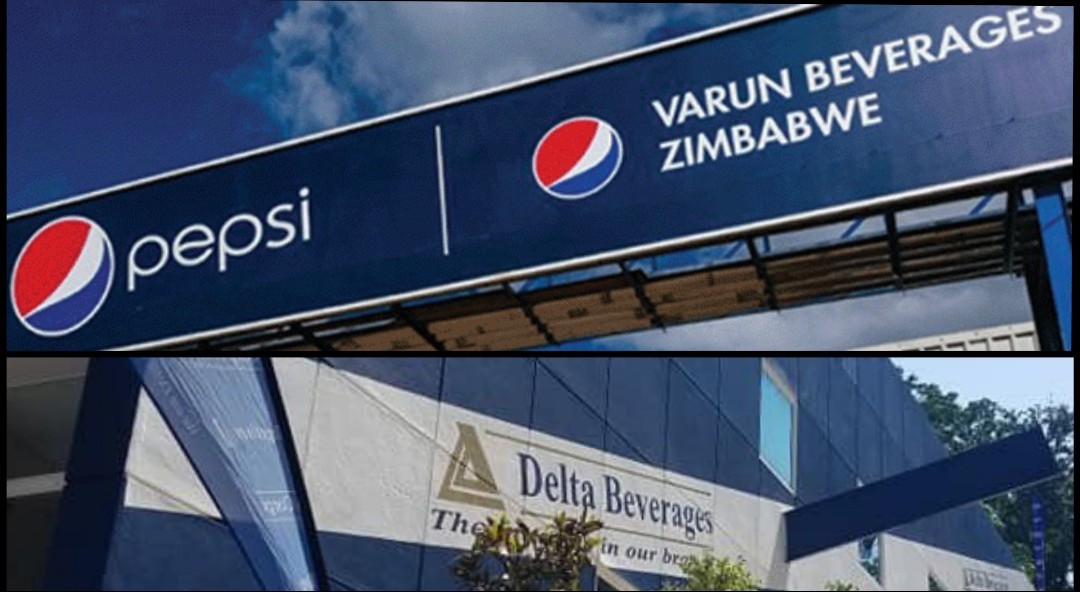
For the longest time, Delta Beverages Pvt Ltd enjoyed a large market share in the Zimbabwean soft drinks market. However, in 2018, VARUN BEVERAGES LIMITEDlaunched in Zimbabwe. It invested USD 110 million, and since then, Varun has been growing rapidly in the past few years. This means that Delta Corporation has been facing competition from Varun Beverages despite an increase in revenue in 2023.

In this article, I will focus on a digital marketing analysis for both Delta, the established leader in the beverage industry, and Varun, the new and innovative player.
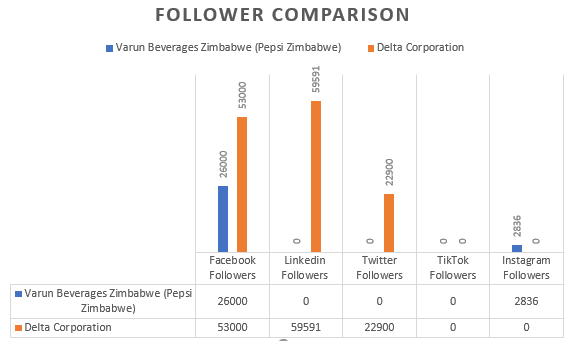
Varun Beverages and Delta Corporation Follower Comparison

First, I looked at the social media presence of the two companies. Varun is only present on Facebook and Instagram with a following of 26,000 and 2,836, respectively. Delta has 53,000 followers on Facebook, but it has the most followers on LinkedIn with 59,591 followers. It also has a decent following on X (formerly Twitter) with 22,900 followers. Both companies are not on TikTok, and Delta is not on Instagram where Varun is present. Based on this analysis, where I looked at five major social media platforms in Zimbabwe, Varun is present on two and Delta is on three. They both need to improve their social media presence, especially considering their size. I give Varun a 3/10 and Delta a 4/10.
Varun Beverages and Delta Corporation Post Analysis

Varun Beverages and Delta Corporation Post Analysis

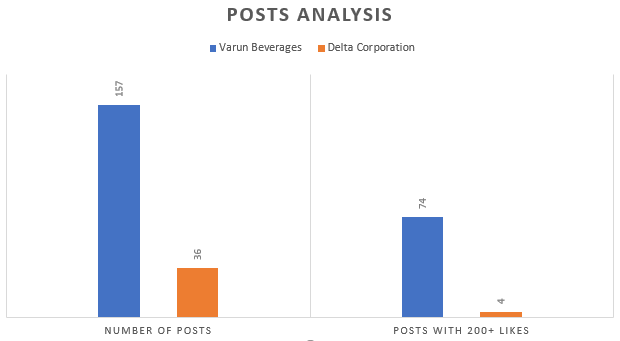
After looking at their social media presence, I went to Facebook, the platform where they are both present, and looked at their post frequency over a period of 85 days, from November 1, 2023, to January 25, 2024. Varun made 157 posts in that period, and 47% of those posts (74 posts) had more than 200 likes. Delta, in the same period, made 36 posts, and only 11% of those posts (4 posts) had more than 200 likes. Based on these results, Varun has more engaging content than Delta. We can attribute this to the fact that Varun posts more than Delta.

Delta Beverages Facebook Followers

Delta Beverages Facebook Followers

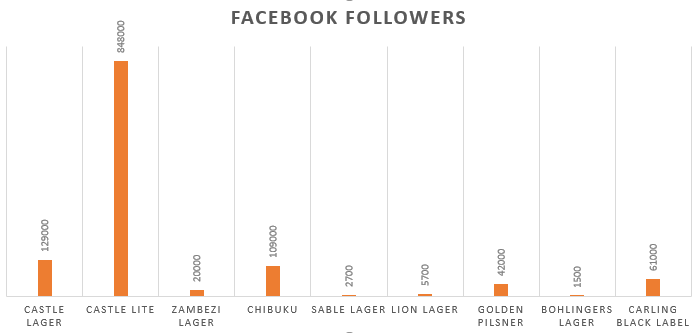
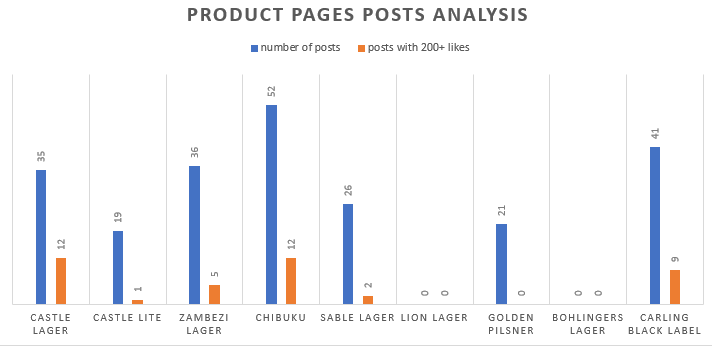
Lets focus on Delta’s product pages on Instagram and Facebook. These pages exclusively promote alcoholic beverages, not non-alcoholic ones. The main outlier on Facebook is the Castle Lite page with 848,000 followers. However, its engagement rate doesn’t match its large following. Between November 1, 2023, and January 25, 2024, they only posted 19 times, and only one post had over 200 likes.
Varun Beverages and Delta Corporation products pages posts analysis

Varun Beverages and Delta Corporation products pages posts analysis

The page with the most posts, Chibuku, has 109k followers and posted 51 times, but only 12 posts garnered over 200 likes. Lion Lager and Bohlingers Lager pages didn’t post at all during this period and also have the lowest follower count. Bohlingers Lager has the fewest followers with 1,500. Castle Lager had the highest engagement rate, with 34% of its 35 posts reaching over 200 likes.
Delta Beverages instagram followers

Delta Beverages instagram followers

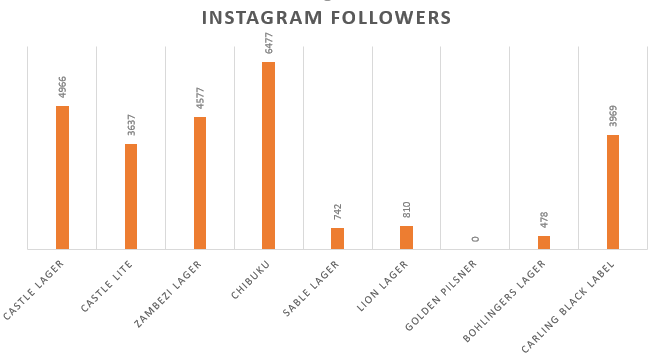
On Instagram, their top-followed product pages are Castle Lager, Castle Lite, Zambezi Lager, Chibuku, and Carling “My Darling” Black Label, all with an average following of 4,725. Golden Pilsner is the only one without a product page, and Bohlingers Lager is still the least followed.

The idea of having separate product pages is strategic. Each product has its own audience, branding, and marketing materials. This approach shifts the focus from Delta as a whole to individual products. It also creates a public relations buffer: in case of a Delta scandal, these pages wouldn’t be affected because they don’t draw attention away from the main Delta page. Similarly, they wouldn’t be compromised in a cyber security breach.

However, I question why they don’t do the same for the soft drinks division. Having a dedicated page or even multiple pages focused on soft drinks would be better than lumping them under the main Delta page. This would better reflect the company’s focus on soft drinks. The content quality and posting frequency on these pages suggest a lack of social media marketing strategies beyond simply posting. While the initiative itself deserves an 8/10, their execution merits a 4/10.

Moving on to websites and SEO, I was surprised to find Varun Beverages Zimbabwe doesn’t have its own website. Delta does have a site with an overall score of 74, which is considered average. Its performance score is only 14/30. The page size is 1.3MB, which is acceptable for loading speed. However, it has 60 page requests, which slows down the site significantly. This is reflected in the page speed of 7.6 seconds, far from the standard of 5.3 seconds. While it passes the browser cache test, has minimal page redirects, perfectly fitting images, and minified Java and CSS, its SEO score is only 25/30. It has a meta description, allows page indexing, and uses content plugins, but lacks descriptive link text. Security-wise, it scores a low 5/10 because it’s an HTTP site, not HTTPS, although it does have secure JavaScript libraries.

Its domain authority (DA) is 31, which needs improvement. It has 224 linking root domains, 19 ranking keywords, and a 1% spam score. The site’s most important page is www.delta.co.zw/ with a page authority of 37. The top linking sites are en.wikipedia.org (DA 98), de.wikipedia.org (DA 94), and sakura.ne.jp (DA 93). Its top ranking keywords are “delta corporation,” “castle lager,” “delta airlines corporate governance,” “nampark,” and “delta core values.” The highest-volume keywords reflecting the brand are “delta corporation” and “delta brewery.”

For site aesthetics, I give it a 7/10.

On Google Maps, searching for “beverages companies in Zimbabwe,” Varun ranks 3rd with a 4/5 rating, Pepsi Zimbabwe ranks 6th with a 4/5 rating, and Delta ranks 8th, 16th, 18th, and 19th with an average rating of 4/5.

Based on my analysis of digital presence:

Varun: 3/10

Delta: 7/10

On content quality:

Varun: 6/10

Delta: 5/10

SEO comparison is difficult since Varun lacks a website.

Varun Beverages

Varun Beverages

large companies should invest in digital marketing. Building dedicated social media teams and crafting individual strategies for each page and product is crucial. Additionally, leveraging platforms like TikTok, now a powerful search engine, is essential. The content they create should not only promote their products but also add value to the audience, stimulate conversations, and encourage engagement.
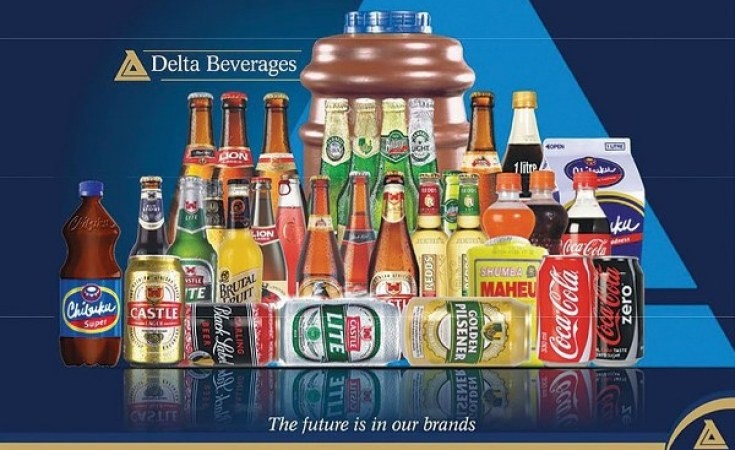
Delta Beverages

Delta Beverages

While Varun excels in traditional marketing with disruptive methods that have fueled its success, neglecting digital marketing would be a mistake. Competition is fierce online as well as offline, and they need a strong digital presence to maintain their market share.

As the established market leader, Delta risks becoming complacent. Varun’s success in the soft drinks sector necessitates a strategic shift for Delta to protect its alcoholic beverage market share. Embracing digital marketing is key to safeguarding their position and remaining competitive.

Source: Simbarashe Mukondo

The Business Diary magazine is a comprehensive publication that centers around business and economic development news. It covers a wide range of topics including finance, mining, technology, environment, climate finance, and agriculture. With its focus on providing valuable insights and updates, the magazine caters to readers who are interested in staying informed about the latest developments and trends in the business and economic landscape of Zimbabwe.

Continue Reading

Business

NESZ 2026: A Convergence of Visionary Leaders Shaping the Future of Education in Zimbabwe

Published

on

NESZ 2026: A Convergence of Visionary Leaders Shaping the Future of Education in Zimbabwe

Zimbabwe stands at a defining moment in its education and development journey.

As the nation accelerates toward a knowledge-driven, innovation-led economy, the National Education Summit Zimbabwe (NESZ) 2026 emerges as a critical platform where policy, practice, and progress converge. Scheduled for 27–30 May 2026 at the Zimbabwe International Trade Fair (ZITF) Grounds in Bulawayo, this year’s summit promises to be the most impactful yet.

Under the theme

“From Policy to Practice: Driving Innovation & Investment in Zimbabwe’s Education System,”
NESZ 2026 brings together an exceptional lineup of speakers—leaders whose influence spans government, academia, industry, and global institutions.

A Powerhouse Line-Up of Speakers

This year’s summit features a distinguished assembly of policymakers and thought leaders at the forefront of Zimbabwe’s transformation agenda.

From government, the summit will host senior leaders responsible for shaping the country’s economic, education, and digital future, including:

  • Hon. Prof. Mthuli Ncube – Minister of Finance, Economic Development and Investment Promotion
  • Hon. Dr. Tatenda Mavetera – Minister of ICT, Postal and Courier Services
  • Hon. Prof. Paul Mavima – Minister of Skills Audit and Development
  • Hon. Edgar Moyo – Minister of Public Service, Labour and Social Welfare
  • Hon. Mangaliso Ndlovu – Minister of Industry and Commerce
  • Hon. Supa Mandiwanzira – Chairperson, Parliamentary Portfolio Committee on Primary and Secondary Education

Adding to this powerful policy voice is Hon. Dr. Frederick Shava, a seasoned diplomat and ambassador, bringing global perspective to Zimbabwe’s development discourse.

Leaders in Education, Innovation, and Human Development

Beyond government, NESZ 2026 features influential educationists, institutional leaders, and changemakers whose work continues to shape learning ecosystems:

  • Sr. Dr. Annah Theresa Nyadombo – Global safeguarding expert and education leader
  • Dr. Anna Moyo – Dean of Education, Midlands State University
  • Mr. Canaan Mpala – General Manager, TelOne Centre for Learning
  • Mr. Amos Guy Ngwarati – Headmaster, Wise Owl High School
  • Mr. Tim Middleton – Executive Director, Association of Trust Schools (ATS)

From grassroots education to higher learning and institutional leadership, these speakers bring a holistic perspective on the challenges and opportunities within Zimbabwe’s education system.

Champions of Empowerment and Enterprise

The summit also highlights leaders driving inclusive economic participation and community transformation:

  • Hon. Getrude Mutandi – Member of Parliament and Chairperson of the Parliamentary Portfolio Committee on Women Affairs, Community and SME Development

Her work, alongside others, underscores the critical link between education, entrepreneurship, and sustainable socio-economic growth.

What to Expect at NESZ 2026

NESZ 2026 is not just a conference—it is a strategic platform for action.

Participants can expect:

  • Policy-to-Practice Conversations

Engage directly with policymakers and decision-makers on how national education policies are being translated into real-world impact.

  • Innovation and Technology Showcases

Experience cutting-edge solutions in education, STEM, and digital transformation aligned with Zimbabwe’s Education 5.0 agenda.

  • Investment and Partnership Opportunities

Connect with investors, corporates, and development partners shaping the future of education and skills development.

  • Thought Leadership and Insight

Gain valuable perspectives from leading voices across education, government, and industry.

  • Networking and Collaboration

Build meaningful connections with educators, innovators, entrepreneurs, and policymakers from across Zimbabwe and beyond.

Why NESZ 2026 Matters

At its core, NESZ is about one thing: transformation.

It is about moving beyond conversations and into implementation.
It is about aligning education with industry, innovation, and national development.
It is about building a system that equips Zimbabweans not just to learn—but to create, lead, and compete globally.

With a speaker lineup of this calibre, NESZ 2026 is poised to spark the ideas, partnerships, and actions that will shape the next chapter of Zimbabwe’s education story.

Be Part of the Movement

📍 Zimbabwe International Trade Fair Grounds, Bulawayo
📅 27–30 May 2026

This is where education meets innovation.
This is where policy meets action.
This is where the future is built.

Register. Participate. Exhibit.

Continue Reading

Business

66th ZITF Opens in Bulawayo: Botswana’s President Duma Boko to Headline ‘Connected Economies’ Fair

Published

on

66th ZITF Opens in Bulawayo: Botswana’s President Duma Boko to Headline ‘Connected Economies’ Fair

The 66th Zimbabwe International Trade Fair (ZITF) officially opens its gates today in Bulawayo Province, marking one of the most anticipated events on Africa’s business calendar.

Running under the theme “Connected Economies, Competitive Industries,” this year’s edition is expected to offer a powerful platform for Africa’s industrial heavyweights. The focus is clear: link manufacturing breakthroughs and digital transformations directly to global value chains.

High-Profile Opening

On Thursday, Botswana President Duma Boko will officially open the exhibition. His presence underscores growing regional cooperation and signals strong confidence in Zimbabwe as a trade and investment hub.

Organisers expect the fair to attract serious deal-making across sectors including manufacturing, technology, agriculture, and logistics.

Strong International Turnout

The numbers speak for themselves:

  • 485 direct exhibitors are taking part

  • 100 leaseholders (permanent or long-term exhibitors)

  • 46 international exhibitors

  • Representing 29 countries from Africa, Europe, Asia, and the Middle East

Full list of participating countries includes:

Africa: Botswana, Eswatini, Ethiopia, Kenya, Malawi, Mozambique, Namibia, Nigeria, South Africa, Tanzania, Zambia, Zimbabwe

Europe: Belarus, Belgium, Denmark, France, Germany, Ireland, Italy, the Netherlands, Sweden, United Kingdom

Asia & Middle East: China, India, Indonesia, Japan, Malaysia, Pakistan, United Arab Emirates (UAE)

Blocs & Others: European Union (EU)

This diverse participation makes ZITF 2026 one of the most internationally connected trade fairs in recent years.

Theme Breakdown: What ‘Connected Economies, Competitive Industries’ Means

The theme is not just a slogan. It reflects three key priorities:

  1. Connected Economies – Stronger trade corridors, simplified cross-border processes, and regional integration through AfCFTA and SADC.

  2. Competitive Industries – Local manufacturers upgrading technology, improving quality, and competing beyond national borders.

  3. Global Value Chains – Positioning Zimbabwe and Africa as reliable suppliers to international markets.

Organisers believe the fair provides a launchpad for African industries to move from survival mode to global competitiveness.

What to Expect at the Fair

Visitors and exhibitors can look forward to:

  • Live demonstrations of new manufacturing technologies

  • Digital transformation showcases

  • B2B matchmaking sessions

  • Policy dialogues on industrialisation

  • Networking with buyers from over two dozen countries

For local businesses, this is a rare opportunity to connect directly with international partners without leaving Bulawayo.

Why This Matters for Zimbabwe

ZITF is more than a trade fair. It is a barometer of economic confidence.

A strong 66th edition sends a clear message:

  • Zimbabwe remains open for business

  • International partners are willing to engage

  • The march toward Vision 2030 (upper-middle-income status) is alive and real

The fair also boosts Bulawayo’s economy, filling hotels, restaurants, and transport services for the week.

Final Word

As the gates open today, all eyes are on Bulawayo.

With Botswana’s President Duma Boko set to speak on Thursday, 29 countries on the exhibitor list, and a theme that prioritises real economic integration, the 66th ZITF is shaping up to be a landmark event.

Stay with The Business Diary for daily updates, interviews, and analysis from the fairgrounds.

Continue Reading

Business

Zimbabwe’s Economic Diplomacy on the Global Stage: Minister Ncube’s Abidjan Engagement

Published

on

Zimbabwe's Economic Diplomacy on the Global Stage: Minister Ncube's Abidjan Engagement

ABIDJAN-In a significant stride for Zimbabwe’s economic revitalization, Hon. Prof. Mthuli Ncube, Minister of Finance, Economic Development, and Investment Promotion, led a high-level delegation to Abidjan on 30 March 2026. The delegation’s primary objective was to engage with Dr. Sidi Ould Tah, President of the African Development Bank (AfDB), to galvanize support for Zimbabwe’s Arrears Clearance and Debt Resolution (AC & DR) Process. This strategic move underscores Zimbabwe’s commitment to re-engaging with international financial institutions and bolstering its economic recovery trajectory.

The visit provided a platform for Minister Ncube to participate in the Strategic Ministerial Dialogue on Debt Sustainability and Financing Africa’s Development Priorities. The dialogue emphasized the imperative of strengthening domestic resource mobilization through digitalization, enhancing public financial management systems, and promoting transparency and accountability in debt reporting. These measures are critical for Zimbabwe as it seeks to optimize its resource utilization and attract sustainable investments.

A key takeaway from the dialogue was the call for prudent debt management, innovative financing instruments, and stronger partnerships to mitigate rising debt vulnerabilities while safeguarding critical development spending. Minister Ncube’s participation in this dialogue highlights Zimbabwe’s proactive approach to addressing its debt challenges and fostering sustainable economic growth.

On the sidelines of the Abidjan engagements, Minister Ncube attended the launch of the Africa’s Macroeconomic Performance and Outlook 2026 Report as a panellist. The report painted a promising picture of Africa’s economic resilience, with a real GDP growth of 4.2% in 2025, surpassing the global average of 3.1%. Growth is projected at 4.3% in 2026 and 4.5% in 2027, with GDP per capita growth standing at 1.9%.

The report’s findings underscore Africa’s potential as a growth hub, notwithstanding risks from debt pressures and external shocks. It recommended coordinated policy action, structural reforms, and targeted investments in job creation, social protection, and human capital development to ensure inclusive and sustainable growth across the continent.

Minister Ncube’s engagement in Abidjan is a testament to Zimbabwe’s commitment to leveraging international partnerships and expertise to drive its economic agenda. The country’s participation in high-level dialogues and strategic engagements is crucial for attracting investments, clearing debt arrears, and fast-tracking economic recovery.

The outcomes of the Abidjan engagements are expected to inform Zimbabwe’s policy direction, particularly in areas of debt management, investment promotion, and economic diversification. As Zimbabwe charts its path towards sustainable development.

In conclusion, Minister Ncube’s Abidjan visit underscores Zimbabwe’s resolve to engage proactively with international financial institutions and development partners. By prioritizing debt sustainability, economic resilience, and inclusive growth, Zimbabwe is positioning itself for a brighter economic future.

Continue Reading

Trending