A university education is far from the only path to success — just ask the nearly 30% of living billionaires who never got even a bachelor’s degree. There’s also a smaller pool of billionaires, living and deceased, who never had any secondary education whatsoever. Find out which notable billionaires found an alternate path to success after skipping the time and money needed for higher learning, and subsequent attitudes to the formal educations they eschewed.
John D. Rockefeller
Net worth (if alive today): $371 billionOil magnate John D. Rockefeller is one of the most famous tycoons and richest men in American history, but the closest he ever came to college was a 10-week business and bookkeeping course taken at Folsom’s Commercial College before starting work at age 16. Rockefeller must have still valued education, though; he later donated millions to the University of Chicago, and helped establish schools and colleges to educate black freedmen after the Civil War.
Henry Ford
Net worth (if alive today): $219 billionHenry Ford left his family farm at 16 for Detroit, where he became a machine shop apprentice and an engineer before revolutionizing transportation and industrial production methods with his assembly-line-enabled Model T Ford. Ford summed up his views on education: “A man’s college and university degrees mean nothing to me until I see what he is able to do with them.”
Richard Branson
Net worth today: $3.9 billion
One of the world’s most recognizable billionaires, Sir Richard Branson dropped out of school due to struggles with dyslexia and poor academic performance at 15, at which point his headmaster speculated he’d either end up a millionaire or in jail. Branson developed his first business, a mail-order record retailer, into the Virgin Group he oversees today, which controls more than 400 companies. “University isn’t the be-all and end-all, and it’s certainly not a prerequisite for business success,” Branson has written. “I’m not saying that people shouldn’t go to university if they want to, but simply calling attention to the benefits of learning from the school of life.”
Liliane Bettencourt
Net worth (if alive today): $47.8 billionLiliane Bettencourt was born the heiress to one of the world’s largest cosmetics companies, L’Oreal, and so had no real need for higher education to achieve her fortune. She joined the family company as an apprentice at 15 and became its principal shareholder from 1957 when she was 35. She was the world’s wealthiest woman when she died in 2017 at age 94 with a $44.7 billion net worth.
Amancio Ortega
Net worth today: $77 billionAmancio Ortega is among the richest men in Europe, best known for co-founding Inditex and its chain of Zara fashion stores in 1975. Ortega left school at the age of 14 and never returned, instead finding work as a shop hand for a shirtmaker where he learned to make clothes by hand. His philanthropic foundation nonetheless devotes considerable funds to education and scholarships.
Ingvar Kamprad
Net worth (if alive today): $51.1 billionAt age 5, Ingvar Kamprad was already displaying a business sense by selling matches around his neighborhood, but he struggled in school due to dyslexia. This may have driven him to choose work over continuing education at age 17, when he founded a mostly mail-order furniture business called Ikea. Today, the store has 445 locations worldwide.
Kirk Kerkorian
Net worth (if alive today): $5.2 billionKirk Kerkorian had a singularly unusual path to success, dropping out of the eighth grade to become an amateur boxer and later a World War II fighter pilot before developing the MGM Grand in Las Vegas. He died in 2015.
François Pinault
Net worth today: $33.5 billionFrançois Pinault founded the French luxury brands group Kering in 1963, and today he has holdings that include Gucci, Samsonite, and Saint Laurent. He left school at 15 when classmates made fun of his rural accent and scruffy clothes.
David H. Murdock
Net worth today: $2.2 billionDavid H. Murdock also took an unconventional path from rags to riches after leaving school in ninth grade. He worked at a gas station before being drafted in World War II, then bought and sold a Detroit diner before acquiring the Hawaiian real estate outfit Castle & Cooke, which happened to own a fruit company called Dole. It’s become the world’s largest fruit and vegetable producer under Murdock.
Carl Lindner Jr.
Net worth (if alive today): $1.9 billionDuring the height of the Great Depression, Carl Lindner Jr. dropped out of school at age 14 to join the family dairy business, which he helped expand into the widely successful convenience chain United Dairy Farmers. Before his death in 2011, Lindner became a prominent donor to the University of Cincinnati and the namesake for the school’s business college, despite his own lack of secondary schooling.
Richard M. Schulze
Net worth today: $3.8 billionBest Buy founder and former CEO Richard Schulze dropped out of Central High School in St. Paul, Minnesota — not that it seems to have held him back, or even kept him off campus: Though his plans to attend college anyway never came to be, Schulze became a donor, trustee, and honorary degree recipient at the University of St. Thomas later in life.
Net worth today: $5.1 billionBritish businessman Joe Lewis made his riches through investing in the international Tavistock Group and currency trading, which led to him being labeled a tax exile and moving to the Bahamas. Before all that, he left school at 15 to help run his father’s London catering business Tavistock Banqueting, which Lewis expanded into selling luxury goods for American tourists, then sold to make his initial fortune.
Alan Sugar
Net worth today: $1.3 billionDropping out of school at age 14 didn’t stop Alan Sugar from finding work as a statistician with the U.K.’s Ministry of Education, then moving on to sell electronics from the back of his van. These humble beginnings led to Sugar gaining his wealth as owner of electronics company Amstrad, as well as being a British media personality and political adviser. When asked if he regrets not getting a formal education, Sugar dismissed university as “a waste of time.”
John Caudwell
Net worth today: $2.8 billionAn English businessman and philanthropist, John Caudwell left school at age 15 and spent some years as a car dealer before getting a certificate in mechanical engineering and entering the mobile provider market with the companies SinglePoint and Phones 4u. He’s vowed to give away half his wealth for charity, and opened the Caudwell International Children’s Centre to study and treat autism.
Laurence Graff
Net worth today: $6 billionNow the multibillionaire founder of jewel supplier Graff Diamonds, Laurence Graff started out cleaning toilets after his mother decided he should leave school due to poor performance when he was 15. In 2008, he founded the Facet Foundation to raise standards of health, education, and well-being in South Africa — where so many diamonds are mined — with leadership and pre-employment skills programs and teacher training.
Roman Abramovich
Net worth today: $10.6 billionRoman Abramovich is a billionaire by virtue of his investments in steel and ownership of the Chelsea Football Club. His humble beginnings include an orphaned childhood in northern Russia and a departure from school at age 17, when he launched his career selling imported rubber ducks. As far back as 2013 he won the distinction of having donated more money than any other living Russian, with a substantial portion going toward education causes. That didn’t stop him from getting sanctioned by the U.K. government following the Russian invasion of Ukraine, and a Jersey court imposed a freezing of his assets that could be worth more than $7 billion.
Haim Saban
Net worth today: $2.9 billionHaim Saban is an Israeli-American media mogul and investor, earning his billions mostly earned by producing children’s programming such as the “Mighty Morphin Power Rangers” for Saban Entertainment and now spends on pro-Israel and Democratic political causes. Growing up, he was expelled from an Israeli boarding school for troublemaking and told by the principal, “You’re not cut out for academic studies; you’re cut out for making money.” Saban finished high school but pursued formal education no further.
John Paul DeJoria
Net worth today: $2.9 billionPaul DeJoria is a self-made entrepreneur and philanthropist best known for co-founding the Paul Mitchell haircare line and Patrón Spirits. He had a rough childhood growing up in Los Angeles, being sent from his mother into foster care and joining a street gang before a high school math teacher inspired him to change. DeJoria finished high school, but joined the Navy and later worked as a salesman rather than attend university.
David Green
Net worth today: $13.9 billion
As the founder of Hobby Lobby, David Green and his family employ more than 43,000 employees at around 900 stores across the nation. He completed high school in Oklahoma but never attended university, instead becoming a retail manager and using a $600 loan to start a home business assembling and selling picture frames. Today, he’s an avid donor to evangelical Christian colleges, even giving an entire campus to the Zion Bible College in 2007.
Harare, Zimbabwe – June 2026 – In a significant development for Zimbabwe’s entrepreneurial and capital markets ecosystem, the Zimbabwe Stock Exchange (ZSE) and the National Venture Capital Company of Zimbabwe (NVCCZ) have signed a Memorandum of Understanding (MOU) aimed at creating a structured pathway for startups and small-to-medium enterprises (SMEs) to access capital markets through the Zimbabwe Entrepreneurship Exchange (ZEEX).
The partnership marks a major step toward bridging the gap between venture capital financing and public market participation, providing entrepreneurs with a clear roadmap from startup funding to long-term growth and investment opportunities.
Creating a Growth Journey for Zimbabwean Enterprises
Historically, venture capital funding and capital markets have operated independently, leaving many promising businesses without a clear route to scale beyond their initial funding stages. Through this partnership, ZSE and NVCCZ seek to change that by establishing a continuum of support that combines financing, governance, compliance readiness, and market access.
The collaboration will focus on identifying high-potential startups and SMEs already supported by NVCCZ and preparing them for eventual participation on ZEEX, Zimbabwe’s newly approved digital capital market platform.
Key Areas of Collaboration
1. Pipeline Development
The two institutions will jointly identify venture-backed businesses with strong growth potential and develop structured graduation pathways that guide them from early-stage financing to public capital market participation. Clear eligibility standards and quality benchmarks will be established to support this transition.
2. Co-Financing and Blended Finance
The partnership will explore innovative financing models that combine venture capital and public market funding. This includes co-investment opportunities and blended finance mechanisms that leverage both public and private sector capital to accelerate business growth.
3. Capacity Building
Recognising that access to capital alone is not enough, the partners will offer training programmes focusing on corporate governance, financial reporting, investor readiness, and compliance with ZEEX listing requirements. Selected enterprises will also receive advisory support to strengthen their readiness for market participation.
4. Market Development
Joint awareness campaigns, investor roadshows, SME financing conferences, and sector-specific financing platforms will be developed to deepen understanding of capital market opportunities among entrepreneurs and investors alike.
5. Product Innovation
The agreement also opens the door for the development of innovative financial products tailored to growth-stage businesses, including SME bond programmes, sustainability-linked instruments, structured SME funds, and alternative digital listing platforms.
Speaking on the partnership, ZSE Holdings Group CEO Justin Bgoni highlighted the importance of creating a structured connection between venture capital and public markets.
He noted that entrepreneurs receiving venture capital support can now see a credible pathway toward public market participation from the outset, providing greater certainty and long-term planning opportunities.
NVCCZ Chief Executive Officer Tinotenda Kambasha described the partnership as a milestone for Zimbabwe’s innovation ecosystem, emphasizing that successful venture investing requires support throughout the entire growth journey of a business.
According to Kambasha, the collaboration will provide venture-backed enterprises with strategic exit opportunities while promoting investor participation, improving liquidity, and enabling the recycling of capital into future generations of innovative Zimbabwean businesses.
What This Means for Zimbabwe
The partnership arrives at a critical time when Zimbabwe is seeking new ways to stimulate entrepreneurship, attract investment, create employment, and accelerate economic growth.
By connecting startups, SMEs, investors, venture capital providers, and the capital markets through ZEEX, the initiative is expected to strengthen financial inclusion, support business formalisation, and create sustainable pathways for enterprise growth.
As ZEEX moves closer to full operationalisation, the growing number of institutional partnerships being secured by ZSE demonstrates increasing confidence in the platform’s potential to transform how Zimbabwean businesses raise capital and how investors participate in the country’s economic development.
For entrepreneurs and investors alike, the ZSE-NVCCZ partnership represents an important step toward building a more vibrant, innovative, and investment-ready Zimbabwean economy.
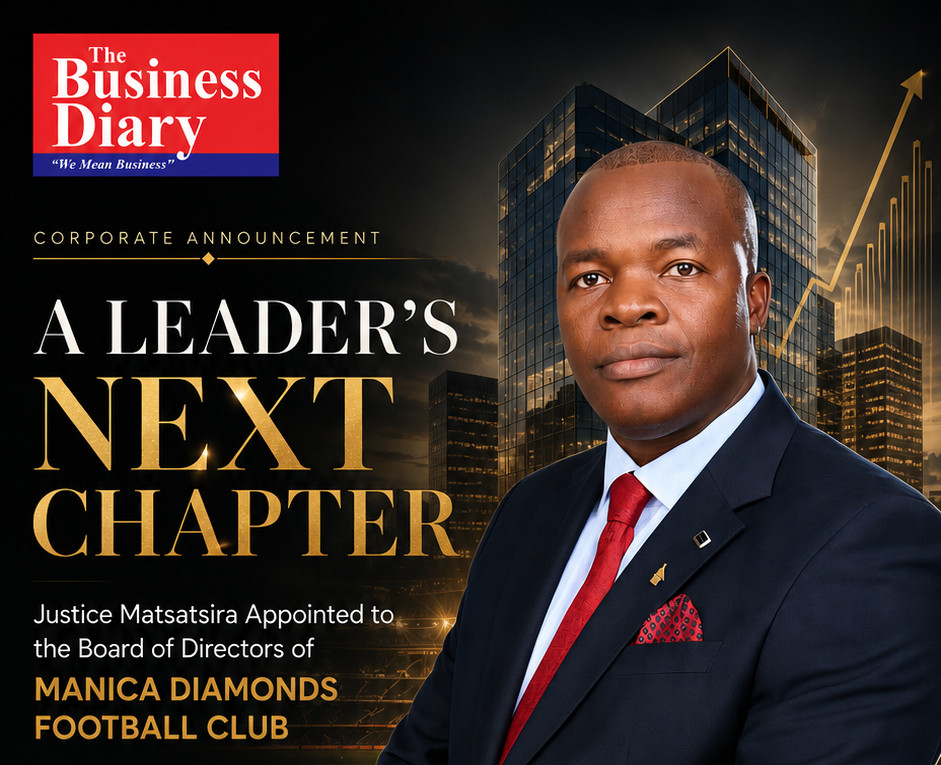
The Business Diary proudly celebrates a significant milestone in the professional journey of its Chief Executive Officer and Publisher, Justice Matsatsira, following his appointment to the Board of Directors of Manica Diamonds Football Club.
This prestigious appointment reflects Mr. Matsatsira’s growing influence as a business leader, strategist, and advocate for sustainable institutional growth. It is a recognition of his unwavering commitment to excellence, visionary leadership, and his continued contribution to Zimbabwe’s economic and social development.
Over the years, Justice Matsatsira has established himself as a respected voice within Zimbabwe’s business community. Through his leadership of The Business Diary, he has played a pivotal role in promoting entrepreneurship, fostering dialogue on economic development, and providing a platform that highlights business opportunities, innovation, and thought leadership across various sectors.
His appointment to the Manica Diamonds Football Club Board comes at a time when football clubs are increasingly embracing professional governance structures and strategic leadership to drive long-term success both on and off the field. Mr. Matsatsira brings with him extensive experience in business development, corporate communications, stakeholder engagement, and strategic management—qualities that will undoubtedly add value to the club’s vision and future aspirations.
Speaking on the significance of leadership, Justice Matsatsira often emphasizes that true leadership is measured not by title, but by impact.
“Leadership is not about position. It is about impact, influence and inspiration.”
This philosophy has guided his professional journey and continues to shape the way he approaches business, community development, and organizational growth.
At The Business Diary, we view this appointment as more than a personal achievement. It is a reflection of the confidence that institutions place in leaders who consistently demonstrate integrity, professionalism, and the ability to deliver meaningful results. We are confident that Justice Matsatsira’s strategic insight and commitment to excellence will contribute significantly to the continued growth and success of Manica Diamonds Football Club.
As he embarks on this exciting new chapter, we extend our heartfelt congratulations and best wishes. We celebrate not only the achievement itself, but the leadership, dedication, and vision that made it possible.
Congratulations, Justice Matsatsira, on your appointment to the Board of Directors of Manica Diamonds Football Club. May this new role bring continued success and create even greater opportunities to inspire positive change.
The Business Diary
Ground Floor, Bard House
69 Samora Machel Avenue
Harare, Zimbabwe
Zimbabwe stands at a defining moment in its education and development journey.
As the nation accelerates toward a knowledge-driven, innovation-led economy, the National Education Summit Zimbabwe (NESZ) 2026 emerges as a critical platform where policy, practice, and progress converge. Scheduled for 27–30 May 2026 at the Zimbabwe International Trade Fair (ZITF) Grounds in Bulawayo, this year’s summit promises to be the most impactful yet.
Under the theme
“From Policy to Practice: Driving Innovation & Investment in Zimbabwe’s Education System,” NESZ 2026 brings together an exceptional lineup of speakers—leaders whose influence spans government, academia, industry, and global institutions.
A Powerhouse Line-Up of Speakers
This year’s summit features a distinguished assembly of policymakers and thought leaders at the forefront of Zimbabwe’s transformation agenda.
From government, the summit will host senior leaders responsible for shaping the country’s economic, education, and digital future, including:
Hon. Prof. Mthuli Ncube – Minister of Finance, Economic Development and Investment Promotion
Hon. Dr. Tatenda Mavetera – Minister of ICT, Postal and Courier Services
Hon. Prof. Paul Mavima – Minister of Skills Audit and Development
Hon. Edgar Moyo – Minister of Public Service, Labour and Social Welfare
Hon. Mangaliso Ndlovu – Minister of Industry and Commerce
Hon. Supa Mandiwanzira – Chairperson, Parliamentary Portfolio Committee on Primary and Secondary Education
Adding to this powerful policy voice is Hon. Dr. Frederick Shava, a seasoned diplomat and ambassador, bringing global perspective to Zimbabwe’s development discourse.
Mr Canaan Mpala, General Manager – Telone Centre for Learning
Dr. Anna Moyo
Hon Tatenda Mavetera
Mr Amos Guy Ngwarati
Hon. Ambassador Dr. Frederick Shava
Hon Edgar Moyo
Hon. Getrude Mutandi – NESZ 2026 Speaker
Hon. Mangaliso Ndlovu
Hon. Dr. Torerai Moyo – Minister of Primary and Secondary Education
Hon. Professor Mthuli Ncube – Minister of Finance
Hon Supa Mandiwanzira
Hon. Dr. Paul Mavima
Sister Dr. Annah Theresa Nyadombo
Tim Middleton – Executive Director for Association of Trust Schools Zimbabwe
Leaders in Education, Innovation, and Human Development
Beyond government, NESZ 2026 features influential educationists, institutional leaders, and changemakers whose work continues to shape learning ecosystems:
Sr. Dr. Annah Theresa Nyadombo – Global safeguarding expert and education leader
Dr. Anna Moyo – Dean of Education, Midlands State University
Mr. Canaan Mpala – General Manager, TelOne Centre for Learning
Mr. Amos Guy Ngwarati – Headmaster, Wise Owl High School
Mr. Tim Middleton – Executive Director, Association of Trust Schools (ATS)
From grassroots education to higher learning and institutional leadership, these speakers bring a holistic perspective on the challenges and opportunities within Zimbabwe’s education system.
Champions of Empowerment and Enterprise
The summit also highlights leaders driving inclusive economic participation and community transformation:
Hon. Getrude Mutandi – Member of Parliament and Chairperson of the Parliamentary Portfolio Committee on Women Affairs, Community and SME Development
Her work, alongside others, underscores the critical link between education, entrepreneurship, and sustainable socio-economic growth.
What to Expect at NESZ 2026
NESZ 2026 is not just a conference—it is a strategic platform for action.
Participants can expect:
Policy-to-Practice Conversations
Engage directly with policymakers and decision-makers on how national education policies are being translated into real-world impact.
Innovation and Technology Showcases
Experience cutting-edge solutions in education, STEM, and digital transformation aligned with Zimbabwe’s Education 5.0 agenda.
Investment and Partnership Opportunities
Connect with investors, corporates, and development partners shaping the future of education and skills development.
Thought Leadership and Insight
Gain valuable perspectives from leading voices across education, government, and industry.
Networking and Collaboration
Build meaningful connections with educators, innovators, entrepreneurs, and policymakers from across Zimbabwe and beyond.
Why NESZ 2026 Matters
At its core, NESZ is about one thing: transformation.
It is about moving beyond conversations and into implementation. It is about aligning education with industry, innovation, and national development. It is about building a system that equips Zimbabweans not just to learn—but to create, lead, and compete globally.
With a speaker lineup of this calibre, NESZ 2026 is poised to spark the ideas, partnerships, and actions that will shape the next chapter of Zimbabwe’s education story.
Be Part of the Movement
📍 Zimbabwe International Trade Fair Grounds, Bulawayo 📅 27–30 May 2026
This is where education meets innovation. This is where policy meets action. This is where the future is built.