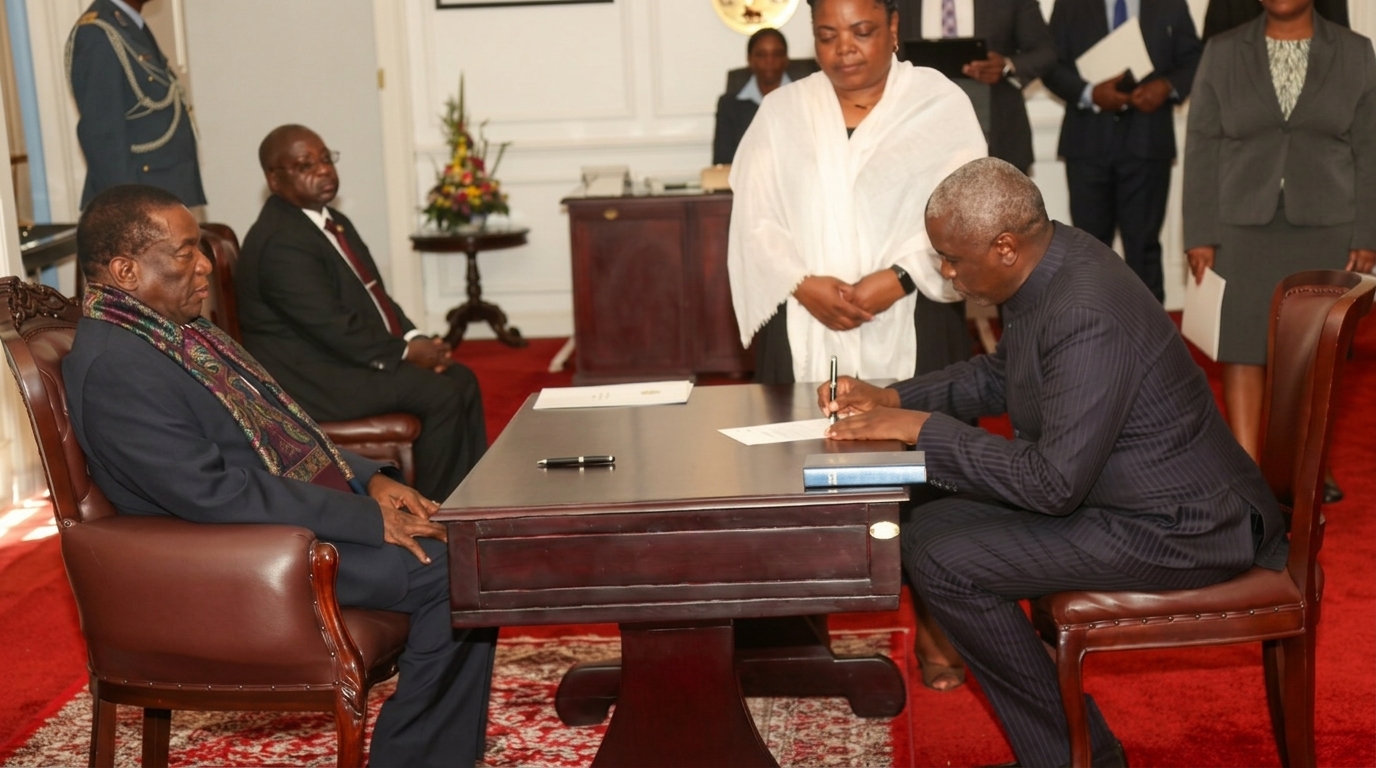
The swearing-in of Kudakwashe Tagwirei as Minister of Economic Development and Investment Promotion places investment mobilisation, industrial expansion and the conversion of economic potential into tangible results at the centre of a newly defined government portfolio.
Zimbabwe’s economic development agenda entered a new phase on Monday, 12 October 2026, when President Emmerson Mnangagwa swore in Senator Dr Kudakwashe Regimond Tagwirei as Minister of Economic Development and Investment Promotion at State House in Harare. The ceremony followed the President’s appointment of Tagwirei to the portfolio on 9 October, alongside the reassignment of Professor Mthuli Ncube to the standalone Ministry of Finance.
The reorganisation separates economic development and investment promotion from the Finance Ministry, creating a distinct ministerial portfolio whose mandate places the attraction of capital, the advancement of economic activity and the implementation of national development priorities at the forefront.
For Zimbabwe, the significance of this change will ultimately depend on how effectively the new ministry translates national ambition into commercially viable projects, productive industries and improved economic opportunities for citizens.
From investment interest to investment delivery
Zimbabwe is not starting from a blank slate. The country has substantial mineral resources, agricultural potential, an established industrial base, a strategic position within Southern Africa and opportunities to expand regional trade.
The challenge has been to convert these advantages into a larger and more diversified productive economy.
According to figures reported by the Zimbabwe Investment and Development Agency (ZIDA), the country approved 378 investment licences valued at more than US$3 billion during the first half of 2026. Mining and manufacturing accounted for significant portions of the investment pipeline. These figures reflect approved investment proposals, however, and should not be confused with capital already deployed or projects fully operational.
This distinction is central to the new ministerial assignment.
An investment licence is an important first step, but its economic value becomes tangible when financing is secured, construction begins, equipment is installed, production starts and workers are employed.
The opportunity before Minister Tagwirei is to help strengthen the systems that move projects through these stages. Closer coordination between investment agencies, regulators, local authorities, financial institutions and infrastructure providers could help investors navigate approval processes, resolve implementation bottlenecks and bring viable projects to market more efficiently.
Such an approach would shift the national conversation from the value of investment announced to the value of investment realised.
A mandate aligned with Vision 2030
The appointment comes as Zimbabwe implements the National Development Strategy 2 (NDS 2), covering 2026–2030. The strategy seeks to accelerate progress towards the country’s ambition of becoming a prosperous and empowered upper-middle-income society by 2030. It emphasises economic transformation, infrastructure development, agricultural productivity, innovation, job creation and stronger international economic engagement.
This framework provides a clear context for the new ministry.
Economic development is not simply a matter of attracting more money into the country. It involves directing investment towards activities that expand productive capacity, strengthen domestic supply chains, increase exports and create sustainable employment.
For Minister Tagwirei, alignment between investment promotion and NDS 2 could provide an opportunity to connect national priorities with the commercial interests of domestic and international investors.
The most consequential investments will be those that create enduring economic value: factories that manufacture locally, mines that develop downstream processing capacity, agricultural enterprises that support agro-processing, and infrastructure projects that reduce the cost of doing business.
The task is to ensure that investment serves as a catalyst for broader economic transformation rather than remaining an isolated collection of individual projects.
Industrialisation: unlocking value beyond raw materials
Zimbabwe’s natural resource endowment presents an important opportunity for economic expansion, particularly when extraction is linked to domestic processing and manufacturing.
In mining, this means creating stronger connections between mineral production and downstream industries. In agriculture, it means moving further along the value chain, from primary production towards food processing, packaging, storage and export-ready products.
The potential benefits extend beyond the industries themselves. A growing manufacturing sector can create demand for transport, engineering, maintenance, packaging, financial services and professional expertise.
For smaller enterprises, stronger domestic value chains can create opportunities to supply larger businesses, participate in procurement programmes and expand into new markets.
The ministry can contribute by helping to coordinate investment opportunities across these interconnected sectors, identifying gaps in industrial capacity and supporting the development of projects with credible commercial prospects.
Energy reliability, transport infrastructure, access to finance and predictable regulation will remain critical to this process. Investment promotion is most effective when the environment in which investors operate supports production, competitiveness and long-term planning.
Building investor confidence
Investment decisions are influenced by more than the availability of natural resources or the size of a potential market. Investors also consider policy consistency, currency and financial risks, the predictability of regulations, the enforceability of contracts and the transparency of public institutions.
Zimbabwe’s ability to attract sustained investment will therefore depend on continued efforts to strengthen these fundamentals.
A credible investment-promotion programme must communicate opportunities clearly while providing investors with reliable information, consistent administrative processes and confidence that published rules will be applied fairly.
It must also demonstrate that investment opportunities are accessible to a broad range of legitimate participants, from major international institutions and regional investors to Zimbabwean entrepreneurs and smaller domestic businesses.
For the new minister, building confidence will require engagement across the investment community and close coordination with the institutions responsible for economic policy, regulation and implementation.
This is particularly important as Zimbabwe seeks to deepen regional trade, attract new productive capital and strengthen its position within African and global value chains.
The international investment community will judge progress not only by the announcements made by government, but also by the consistency of policy, the transparency of processes and the results delivered on the ground.
The significance of business leadership in public service
Tagwirei enters the portfolio with a background in business, including interests associated with Sakunda Holdings across sectors such as energy and agriculture. His experience in the commercial environment may offer familiarity with the practical considerations involved in operating businesses, mobilising resources and assessing investment opportunities.
That experience could be relevant to a portfolio concerned with the relationship between policy and enterprise. Understanding the challenges faced by investors can help inform discussions about project financing, infrastructure constraints, regulatory procedures and the conditions required for commercial activity to expand.
However, public office carries responsibilities that differ fundamentally from those of private enterprise. The ministerial role requires decisions to serve the national interest, with public confidence supported by accountability, transparent procedures and the consistent application of the law.
The opportunity is to apply commercial understanding within a framework of public service, ensuring that investment promotion is conducted in a manner that strengthens confidence in Zimbabwe’s institutions and supports fair economic participation.
For a country seeking to expand its investment base, the credibility of the process is as important as the opportunities being promoted.
What could this mean for Zimbabwean businesses?
A more effective investment-promotion framework could have benefits that extend well beyond large corporations.
For small and medium-sized enterprises, new industrial and infrastructure projects can create opportunities to supply goods and services, develop specialist capabilities and establish longer-term commercial relationships.
For farmers, investment in processing, storage, logistics and agricultural technology can help improve market access and reduce losses along the supply chain.
For young people entering the labour market, new productive enterprises can create demand for technical skills, professional services and entrepreneurship.
For established manufacturers, a more predictable business environment can support decisions to expand capacity, upgrade equipment and develop new products.
These outcomes are not automatic. They depend on the quality of investment, the strength of local supply chains, the availability of skills and the ability of businesses to compete. Nevertheless, they provide a practical way of assessing whether investment promotion is delivering benefits beyond headline figures.
The public interest lies in ensuring that economic growth generates opportunities across sectors, provinces and communities.
The priorities that will define the next chapter
As the ministry begins its work, several priorities are likely to be central to its contribution to the national development agenda.
First, converting approved investments into operating projects. Greater attention to implementation milestones, project financing and the removal of administrative bottlenecks could help narrow the gap between investment approvals and realised capital.
Second, strengthening coordination across government. Investors often require decisions and services from several institutions. Better coordination can help reduce uncertainty and improve the experience of doing business.
Third, prioritising productive and export-oriented investment. Projects that expand manufacturing, support mineral beneficiation, strengthen agro-processing and develop competitive services can contribute to diversification and foreign-exchange generation.
Fourth, broadening participation in economic growth. Local suppliers, small businesses, young entrepreneurs and skilled professionals should have opportunities to participate in the commercial activity generated by new investments.
Fifth, strengthening transparency and accountability. Clear investment criteria, predictable regulations and measurable performance indicators can help demonstrate that opportunities are being pursued in the national interest.
Together, these priorities offer a practical framework for translating the ambitions of NDS 2 into measurable economic outcomes.
Measuring success by results
Minister Tagwirei’s appointment creates an opportunity to sharpen the focus on investment delivery and economic development. The scale of that opportunity should not obscure the complexity of the task.
Zimbabwe’s economic prospects will be influenced by domestic policy choices, global market conditions, access to finance, infrastructure capacity and the competitiveness of local industries. No single ministry can resolve all these challenges independently.
The new portfolio can nevertheless play an important coordinating role by bringing investors, government institutions and productive sectors around a common set of national priorities.
Over time, progress should be assessed through evidence: the amount of investment actually deployed, projects completed, productive capacity added, exports generated, businesses supported and sustainable jobs created.
These are the indicators that connect economic policy to the lived experience of Zimbabweans.
A new chapter, with results to deliver
President Mnangagwa’s decision to establish a distinct economic development and investment promotion portfolio places renewed emphasis on the relationship between investment, production and national development.
For Tagwirei, the immediate task is to turn that mandate into a clear programme of action, working with government institutions and the private sector to improve the conditions for productive investment.
The opportunity is significant. Zimbabwe has resources to develop, agricultural potential to unlock, industries to expand and entrepreneurs capable of creating new enterprises. Converting these strengths into sustained prosperity will require sound policy, effective institutions, investor confidence and consistent implementation.
The measure of this new chapter will not be the appointment itself, but what follows: investments realised, industries strengthened, opportunities expanded and economic value created for the nation.
For Zimbabwe, that is the promise against which the work of the Ministry of Economic Development and Investment Promotion will be judged.
Editorial note: This article is based on publicly reported appointment and swearing-in details, published investment-approval figures and Zimbabwe’s NDS 2 development framework. Projections concerning the ministry’s potential impact are analysis, not claims that those outcomes have already been achieved.
The Business Diary – Telling Zimbabwe’s Business Story | “We Mean Business”