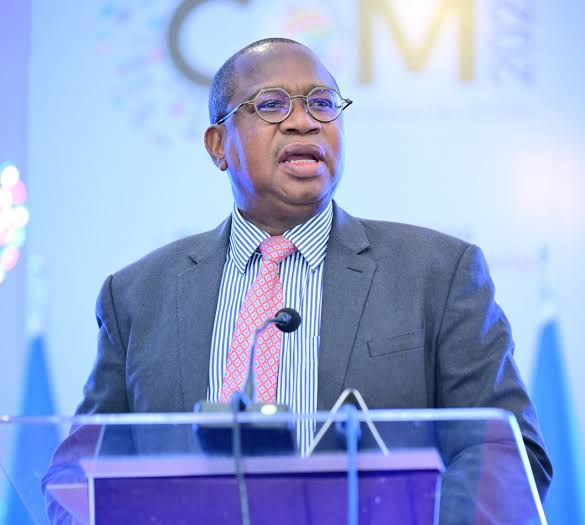
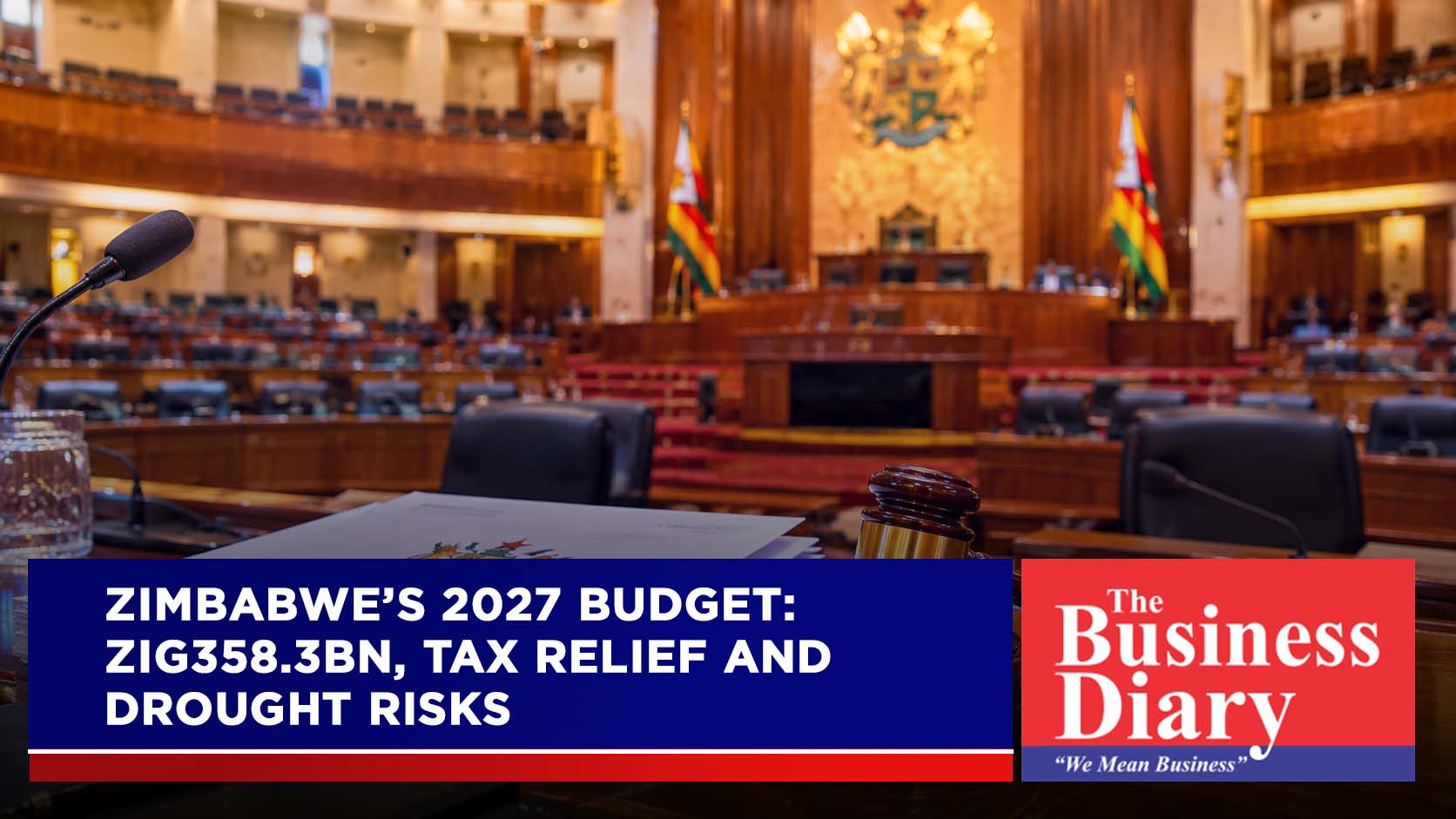
HARARE, 19 November 2026 – Finance Minister Mthuli Ncube on Thursday presented a ZiG358.3 billion (about US$12.8 billion) national budget for 2027 to Parliament. It combines targeted tax relief with a larger contingency reserve, as Treasury braces for a drought that could slow the economy.
The budget, delivered at the New Parliament Building in Mt Hampden under the theme “Accelerating Economic Transformation and Building Resilience to Climate and Global Shocks”, proposes tax relief measures while maintaining the existing tax framework and rates. Treasury expects the revenue forgone from selected tax adjustments to be offset partly by improved economic activity, consumption and compliance.
From 1 January 2027, the monthly tax-free income threshold rises from US$100 to US$150, or the ZiG equivalent, with tax bands adjusted accordingly. The Intermediated Money Transfer Tax (IMTT) falls from 1.5 percent to 1.25 percent on ZiG transactions and from 2 percent to 1.75 percent on foreign currency transfers.
The 25 percent customs duty on cellular phones is scrapped, while the duty on electric vehicles falls from 25 percent to 10 percent. Customs duty on semi-knocked-down kits imported by approved local assemblers of motorcycles, tricycles, trucks and electric commercial vehicles is suspended from 1 December 2026. A duty rebate for the fertiliser manufacturing value chain took effect on 1 November 2026.
The hybrid excise duty on cigarettes will be replaced by a specific duty of US$15 per 1,000 sticks from 1 January 2027. From the same date, Government, mining companies and large entities must source at least 15 percent of their inputs locally where capacity exists, with the supporting framework due by 31 March 2027.
Treasury projects revenue of ZiG349.5 billion (US$12.5 billion), leaving a deficit of about ZiG8.8 billion, or roughly US$300 million, equivalent to 0.5 percent of gross domestic product. Growth is forecast at 3.5 percent in 2027, down from an estimated 5 percent in 2026 and 8.3 percent in 2025. Ncube cited weaker commodity prices and drought risk.
A ZiG10.9 billion (about US$400 million) contingency reserve, financed from 2026 fiscal buffers, is intended to cushion severe shocks. Government expects a potential cereal deficit of up to 541,881 tonnes. The Grain Marketing Board had bought 365,000 tonnes by the end of October towards a 600,000-tonne strategic reserve. Treasury has also taken out African Risk Capacity drought insurance at a US$3.4 million premium. Zimbabwe received a US$31.8 million payout from the same facility after the 2023/24 drought.
Education receives the largest allocation at ZiG47.7 billion, followed by Health at ZiG35.5 billion and Agriculture at ZiG27.6 billion. Defence is allocated ZiG23.4 billion, Home Affairs ZiG21.8 billion and Social Welfare ZiG21.5 billion. Devolution transfers total ZiG17.5 billion, transport infrastructure ZiG10.8 billion and housing ZiG1.5 billion. New Zimbabwe reported that security-related ministries combined would receive ZiG59.5 billion. It noted that agriculture and climate ranked only fourth among national priorities despite the drought warning.
Ministries submitted spending bids of ZiG974 billion, nearly three times the budget ceiling. Treasury will now require prior approval for contracts above US$2 million and says it will enforce the Public Finance Management Act against projects started outside the approved framework.
Background
The budget is the second under the National Development Strategy 2 (NDS2), which covers 2026 to 2030 and targets upper-middle-income status by 2030. Treasury says the economy has grown to about US$66 billion, from US$21 billion in 2019. ZiG inflation averaged 4.0 percent over the first ten months of 2026, and foreign currency receipts rose 33.7 percent to US$15.9 billion in the first nine months.
Public and publicly guaranteed debt stood at about ZiG594.1 billion (US$22.2 billion, or 33.4 percent of GDP) at the end of September 2026. Of that, ZiG331.2 billion is external and ZiG262.9 billion is domestic. Ncube said Zimbabwe plans to clear overdue payments to the World Bank, the African Development Bank and the European Investment Bank by the end of March 2027, according to Reuters. He pointed to Zimbabwe’s exit from the World Bank’s fragile-states list on 1 July 2026, its admission to the BRICS New Development Bank and its election to the UN Security Council for 2027–2028 as signs of improved standing.
Treasury plans to lift capital expenditure from 2.3 percent of GDP in 2026 to 3.8 percent in 2027 and 8.8 percent by 2030. It aims to cut the wage bill from 52.3 percent of the budget to 38.1 percent over the same period.
Business Diary Analysis
The budget is attempting to balance four competing priorities: easing the tax burden, stimulating industrial production, maintaining fiscal discipline and preparing for climate-related shocks. These objectives are mutually reinforcing in theory, but their execution will determine whether they translate into stronger economic activity.
The increase in the tax-free income threshold and reductions in IMTT put more money into household and business cash flow. For workers, the higher threshold offers some relief against living costs. For businesses, lower transaction taxes marginally reduce the cost of moving money through formal payment channels. The impact, however, will depend on whether the savings are sufficient to encourage consumption, investment and greater use of formal financial systems.
The industrial policy measures are more consequential over the longer term. Lower cellphone duties could improve access to digital technology, while EV duty reductions, vehicle assembly incentives and fertiliser manufacturing rebates are designed to support investment, local production and value addition. The 15 percent local procurement requirement could create demand for domestic manufacturers and suppliers, particularly those serving mining, construction, agriculture and public-sector procurement.
But tax relief alone does not guarantee industrialisation. Manufacturers still face constraints related to finance, electricity reliability, machinery, technology, imported inputs and demand. The local procurement requirement will be meaningful only if domestic suppliers can meet quality, price, volume and delivery standards. The implementation framework due in March will therefore be critical in determining whether the measure creates sustainable business opportunities or remains largely a policy target.
Fiscal discipline is the other test. Treasury is projecting a deficit of just 0.5 percent of GDP while ministries submitted spending bids nearly three times the approved expenditure ceiling. The requirement for prior Treasury approval of large contracts and enforcement of the Public Finance Management Act signal an effort to contain unbudgeted expenditure and protect the fiscal framework.
That discipline could strengthen confidence in the budget if Government avoids accumulating arrears, making unplanned commitments or delaying payments to contractors and suppliers. However, tighter controls could also slow project implementation if approval systems are inefficient. The challenge is not simply to restrict expenditure, but to ensure that limited resources are released predictably and spent on productive priorities.
Drought risk could complicate all three objectives. A weaker agricultural season could reduce output, raise food prices, weaken rural incomes, increase import requirements and place pressure on fiscal revenue. It could also affect electricity generation, industrial production and transport activity. The US$400 million contingency reserve provides a meaningful buffer, but it is not a substitute for sustained investment in irrigation, water infrastructure, climate-resilient agriculture and efficient grain procurement.
The reserve is also a one-off cushion financed from accumulated fiscal buffers. Its effectiveness will depend on the scale of the shock, the speed at which resources can be deployed and the Government’s ability to preserve fiscal stability while responding to emergencies.
The budget therefore places a premium on execution. Zimbabwe has tax relief intended to stimulate demand, industrial incentives intended to increase domestic production, spending controls intended to protect stability and contingency resources intended to absorb climate shocks. If these measures are implemented consistently, they could support business confidence and strengthen resilience. If implementation falters, the country could face the familiar gap between policy ambition and economic outcomes.
Conclusion
The 2027 budget is cautious, offering targeted tax relief and industrial incentives while protecting a narrow fiscal deficit and preparing for a potentially difficult agricultural season. It seeks to put more money into consumers’ pockets, lower selected business costs and encourage domestic production without compromising fiscal stability.
Its success will depend on whether the rains hold, revenue meets the ZiG349.5 billion target, industrial incentives attract productive investment and Treasury enforces spending discipline. The Finance Bill, which will turn the proposals into law, is expected to be debated in the coming weeks.