
Connect with us

Investment & Trade

WestProp and Exemplar REITail Draw Near-Full Tenant Demand for US$100 Million Mall of Zimbabwe

WestProp Holdings and South African partner Exemplar REITail have recorded near-full tenant application uptake for the US$100 million Mall of Zimbabwe in Borrowdale, targeting a Q1 2027 groundbreaking and a December 2028 opening.


Published

on

WestProp and Exemplar REITail Draw Near-Full Tenant Demand for US$100 Million Mall of Zimbabwe

HARARE — Victoria Falls Stock Exchange-listed property developer WestProp Holdings and its Johannesburg-listed partner Exemplar REITail have recorded nearly full tenant application uptake for the planned US$100 million Mall of Zimbabwe in Borrowdale, moving the long-delayed retail project toward groundbreaking in the first quarter of 2027.

Speaking at a tenant launch event in Harare on Tuesday, November 24, WestProp chief executive Ken Sharpe said the development has attracted applications across more than 120 retail spaces. The joint venture partners are now conducting a vetting and refinement process expected to take between two and six months to convert those applications into binding leases.

Sharpe placed the project’s estimated cost at US$100 million and said access roads are being completed ahead of civil works, with developers targeting a December 2028 opening. Funding discussions with financiers are also at an advanced stage.

The Mall of Zimbabwe has been in development for more than a decade, shaped by earlier planning delays and design revisions. Exemplar REITail, led by chief executive Jason McCormick and rooted in the portfolio of South Africa’s McCormick Property Development, is handling leasing and brings extensive retail property experience across southern Africa. Early restaurant brands lined up for the scheme include South African operators Spur, Ocean Basket, RocoMamas, and Doppio Zero.

Designed to deliver up to 90,000 square meters of lettable space, the facility would be the largest retail mall built in Zimbabwe in a decade, eclipsing most ongoing local retail developments that typically range between 7,500 and 12,000 square meters.

For Sharpe, who founded WestProp in 2007, the Borrowdale scheme represents the largest retail project in a portfolio that already includes Millennium Heights and Pomona City in Harare, as well as the Chivhu EcoCity project south of the capital. On the day of the tenant launch, Sharpe was also named Zimbabwe’s top private-sector chief executive.

The Business Diary magazine is a comprehensive publication that centers around business and economic development news. It covers a wide range of topics including finance, mining, technology, environment, climate finance, and agriculture. With its focus on providing valuable insights and updates, the magazine caters to readers who are interested in staying informed about the latest developments and trends in the business and economic landscape of Zimbabwe.

Continue Reading

Business & Economy

Zimbabwe and Kenya Sign Seven Agreements as Trade Reaches US$57.6m

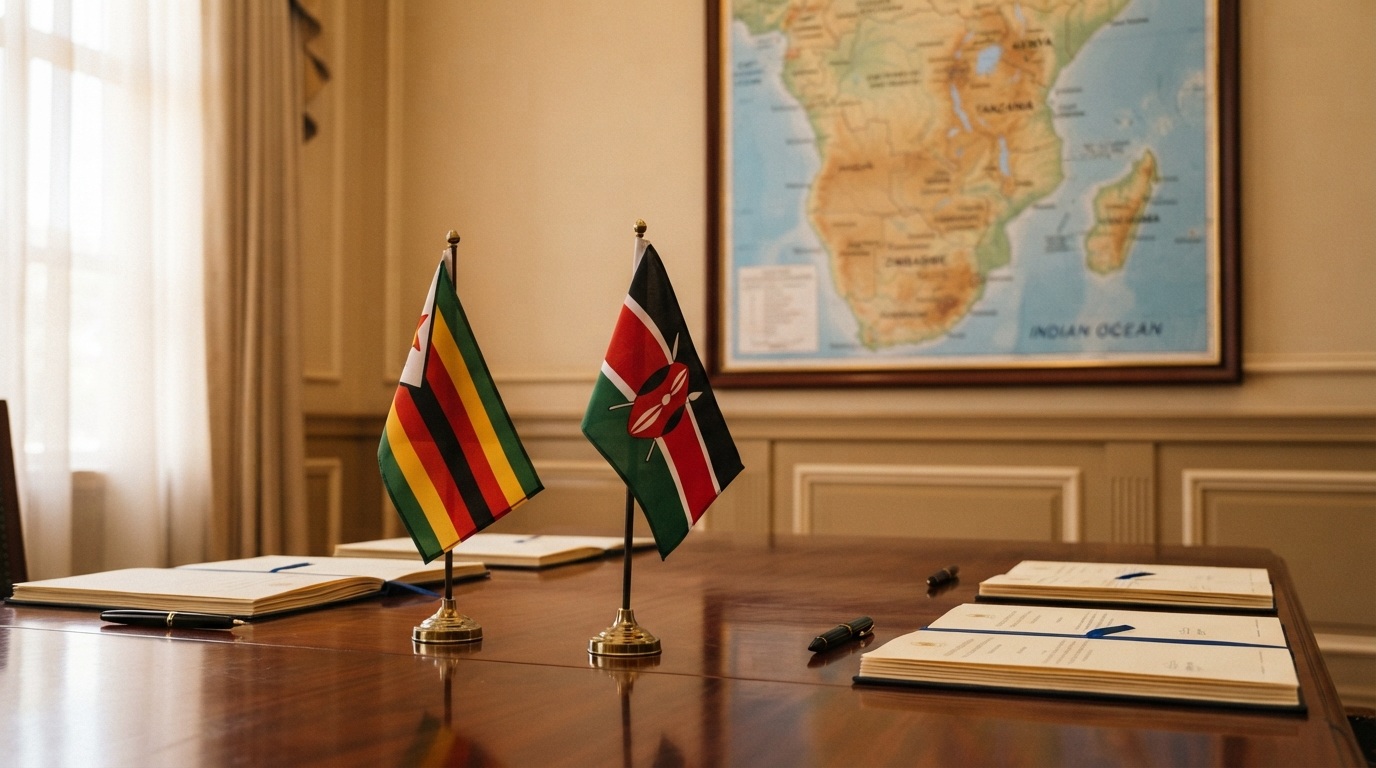
Presidents Emmerson Mnangagwa and William Ruto upgraded the two countries’ cooperation framework to a Bi-National Commission in Nairobi on Friday. The new deals cover housing, customs and trade promotion, while tax, extradition and energy pacts remain unfinished.
Bilateral trade rose 63% to US$57.6 million in 2025. It is still dominated by Zimbabwean tobacco and sugar.
Published

on

Zimbabwe and Kenya Sign Seven Agreements as Trade Reaches US$57.6m

NAIROBI: Zimbabwe and Kenya signed seven memoranda of understanding on Friday, 27 November 2026, at State House in Nairobi. The signing followed the inaugural Bi-National Commission, co-chaired by Presidents Emmerson Mnangagwa and William Ruto.

The Bi-National Commission replaces the Joint Permanent Commission on Cooperation, which was led by ministers. The new body sits at head-of-state level. Mr Mnangagwa told Kenyan officials that the upgrade reflects the growing strength of the two countries’ ties.

The seven memoranda cover affordable housing and building technologies, immigration and migration management, diplomatic training, arts and heritage, news exchange between their state agencies, customs mutual assistance, and trade promotion. The trade promotion pact is between the Kenya Export Promotion and Branding Agency and ZimTrade. The customs agreement commits both sides to help each other facilitate lawful trade and combat customs offences. Mr Ruto said the new agreements bring the total number of bilateral instruments to 24.

“Our focus now is implementation,” Mr Ruto said, according to the Kenya Broadcasting Corporation. He said the two sides were still negotiating agreements on extradition, mutual legal assistance, transfer of sentenced persons, prisons and correctional services, energy, maritime affairs and avoidance of double taxation. Both governments have told their teams to finalise them quickly. The leaders will meet again in Zimbabwe on a date to be agreed to review progress.

Trade figures

Trade between the two countries grew from US$35.3 million in 2024 to US$57.6 million in 2025, an increase of about 63%. Both governments have targeted US$70 million a year by the end of 2026. No 2026 figures have been published. Reaching the target would need a further rise of about 22%.

Mr Ruto estimated that the two countries could unlock about US$53 million in additional export opportunities. He said Kenya could expand exports of processed palm oil, cement clinker and coated iron and steel products. Zimbabwe could expand sugar products and ceramic tiles.

Zimbabwe’s current exports to Kenya are narrow. ZimTrade data cited by Zimbabwe Situation put tobacco at about US$12 million and sugar at about US$7 million in 2025, roughly 95% of the total. The reports reviewed give no figure for the overall trade balance or for Kenya’s exports to Zimbabwe.

Pending steps

Both sides agreed to reduce tariff and non-tariff barriers, simplify customs procedures, ease cross-border payments and harmonise standards. They plan cooperation in agriculture, including agro-processing, storage and cold chains, and in mining, including exploration, technology transfer and processing. A Kenya-Zimbabwe Business Forum is scheduled for 2 February 2027 in Nairobi.

Zimbabwe has proposed an in-market warehouse in Kenya to cut delivery times and logistics costs for small farmers and small businesses. It is a proposal only. The investment agencies, ZIDA and KenInvest, are exploring reciprocal opportunities. Kenya Airways is seeking approval for fifth-freedom traffic rights on the Harare–Johannesburg route. The leaders also welcomed Nairobi’s air links to Harare and Victoria Falls.

Mr Ruto also said Western sanctions on Zimbabwe are unfair and unnecessary and disproportionately affect its citizens. Kenya has made similar statements before, including during his April 2024 state visit to Zimbabwe.

Background

The commission builds on Mr Ruto’s visit to the Zimbabwe International Trade Fair in Bulawayo in April 2024. In October 2026, Mr Ruto handed the chairmanship of the Common Market for Eastern and Southern Africa (COMESA) to Mr Mnangagwa at the bloc’s summit in Harare. At the handover Mr Ruto said he had introduced Mr Mnangagwa to an African investor with an interest in Zimbabwe. He said the investor claimed US$1.7 billion to invest. The investor was not named, and no sectors or timeline were given.

Zimbabwe’s Foreign Affairs Minister, Professor Amon Murwira, said the commission aims to turn political goodwill into commercial exchanges. He also said Zimbabwe no longer exports raw minerals as a matter of policy.

Business Diary Analysis

The following is analysis, not reported fact. The agreements signed on Friday are mostly enabling instruments. They create channels for trade, customs cooperation and promotion but commit no money. The instruments that would change business costs are still unsigned. Avoidance of double taxation is the most important for companies. Energy, maritime affairs and extradition follow.

The trade is small and lopsided. At US$57.6 million, it is a fraction of Kenya’s total imports, which Zimbabwe Situation put at about US$22 billion in 2025. Tobacco and sugar make up almost all of Zimbabwe’s exports. On those figures, Zimbabwe’s exports to Kenya were about US$20 million, which would imply a deficit with Kenya of roughly US$37 million. That is a derived estimate to be checked against ZIMSTAT and Kenyan data.

Zimbabwean exporters will have to diversify beyond leaf and sugar. Kenya’s suggested opportunities in sugar products and ceramic tiles are a start. The Kenyan side’s palm oil, clinker and coated steel offer Zimbabwean manufacturers competition as well as supply. Kenya’s own sugar market has been supplied mostly through imports, so Zimbabwean sugar faces COMESA competition.

Three things will show whether the commission delivers. One is the signing of the double taxation agreement. Another is the 2026 trade figure against the US$70 million target. The third is whether the February 2027 business forum produces contracts and not just introductions.

Sources: AllAfrica: Mnangagwa in Kenya for inaugural BNC, KBC: seven MoUs, Zimbabwe Situation: BNC opens new economic opportunities, Dawan Africa: Ruto hosts Mnangagwa, AllAfrica: Ruto hands COMESA chair to Zimbabwe, Herald: Zim, Kenya must leverage rich shared history

Continue Reading

Investment & Trade

China Railway Resources and Duration Gold Sign US$600 Million Zimbabwe Gold Mining MoU

China Railway Resources Group Co. Ltd and Duration Gold Limited have signed a landmark Memorandum of Understanding in Harare to explore over US$600 million in joint investments across four historic Zimbabwean gold assets, a move projected to create more than 5,000 permanent jobs.

Published

on

China Railway Resources and Duration Gold Sign US$600 Million Zimbabwe Gold Mining MoU

HARARE — Zimbabwe’s gold mining sector has secured a major capital commitment following the signing of a Memorandum of Understanding (MoU) between China Railway Resources Group Co. Ltd (CRRG) and Zimbabwe-focused miner Duration Gold Limited for a prospective joint investment exceeding US$600 million.

Executed in Harare on Thursday by CRRG Chief Executive Officer Shi Yuan and Duration Gold Managing Director Allan Dolan, the framework agreement establishes a pathway to revive, modernize, and expand four brownfield gold assets across the country.

The planned capital deployment targets Mining Lease 16 at Vubachikwe in Gwanda, Mining Lease 47 at Gaika in Kwekwe, Mining Lease 48 at Athens in Mvuma, and the Filabusi Project, which incorporates the Royal Family claims block. All four properties have recorded historical gold production and are supported by recently completed mineral resource assessments prepared under the internationally recognized JORC code, alongside positive preliminary scoping studies.

Under the proposed partnership structure, CRRG—a wholly owned subsidiary of Fortune Global 500-listed infrastructure giant China Railway Group (CREC)—will contribute project financing, heavy engineering capacity, and modern mine development technology. Duration Gold brings two decades of local geological exploration and an established portfolio of mining leases. CRRG already maintains an extensive African operational footprint, including major copper-cobalt assets in the Democratic Republic of Congo.

Speaking at the Harare signing ceremony, Mr. Dolan noted that the agreement marks a turning point after 21 years of exploration and asset consolidation in Zimbabwe. He emphasized that CRRG’s technical scope encompasses every segment of the four properties, from tailings dump retreatment and open-pit expansion to deep underground mining and greenfield exploration.

Mr. Shi indicated that the Chinese resource group intends to introduce artificial intelligence-driven, smart mining techniques and digital integration to convert the sites into long-life, large-scale operations.

Once fully developed, the four projects are projected to generate more than 5,000 permanent jobs and contribute hundreds of millions of dollars in corporate taxes and royalties to the national fiscus. While the MoU sets the commercial and technical framework for joint development, definitive financing schedules and construction timelines will be finalized as joint due diligence and project structuring progress.

The agreement comes amid sustained momentum in Zimbabwe’s bullion industry, supported by firm global gold prices. National gold deliveries reached a record 46.7 metric tonnes in 2025, with industry projections pointing toward output exceeding 50 tonnes in 2026 as large-scale producers expand milling capacity.

Continue Reading

Business & Economy

ZSE Opens SME Funding Platform as Mwana Group Seeks US$1m in First ZEEX Listing

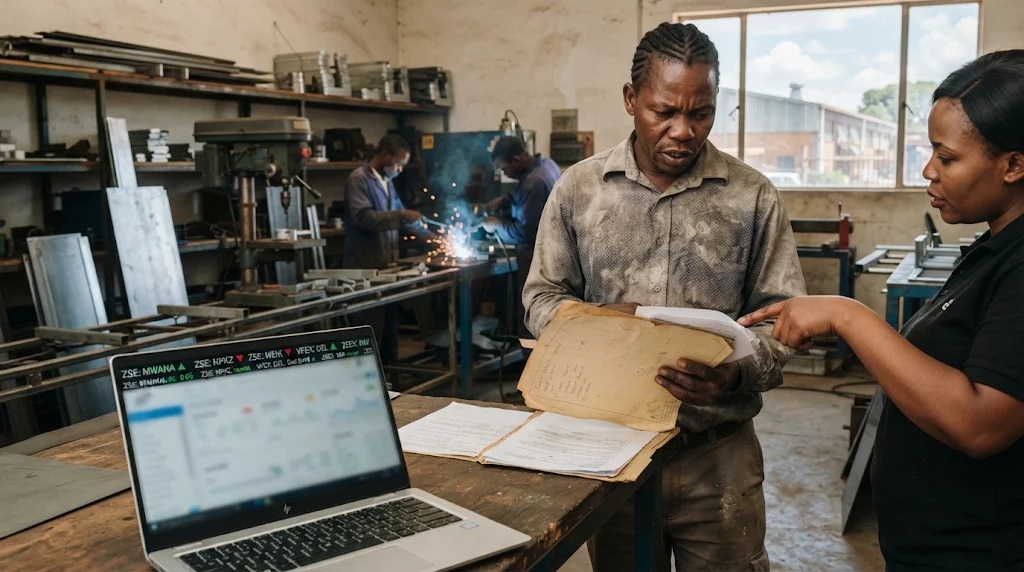
The Zimbabwe Stock Exchange group has opened a regulated route for small and medium enterprises to raise capital from investors. Mwana Group, which is seeking US$1 million to expand production, is set to be the platform’s first listed company. The test will be whether investors and entrepreneurs use it.

Published

on

ZSE Opens SME Funding Platform as Mwana Group Seeks US$1m

HARARE – The Zimbabwe Stock Exchange (ZSE) group has opened a new capital-raising pathway for small and medium enterprises (SMEs), and Mwana Group is set to become its first listed company. Mwana is seeking US$1 million to expand production.

The platform is the Zimbabwe Entrepreneurship Exchange (ZEEX). It is regulated by the Securities and Exchange Commission of Zimbabwe and sits within ZSE Holdings alongside the ZSE and the Victoria Falls Stock Exchange (VFEX). Finance Minister Mthuli Ncube launched it in Bulawayo on Friday, 24 July 2026, according to NewsDay.

Mwana Group’s initial public offering (IPO) has opened ahead of an expected listing this year, according to a Herald commentary published about two weeks ago. The ZEEX has also said the offer is open for subscription on its website. The Business Diary could not obtain the offer price, closing date or number of shares.

Background

The ZSE’s own difficulties lie behind the new platform. The main board has lost companies in recent years, including Econet Wireless Zimbabwe, which delisted in March. Its market capitalisation fell to about US$2.58 billion at the end of April, while the VFEX stood at US$3.53 billion. In June the exchange temporarily cut its minimum listing capitalisation from US$10 million to US$1 million for 36 months and waived initial listing fees.

ZEEX operates in two parts. Private Markets lets issuers raise funds from qualified investors without listing or secondary trading. Public Markets offers listing and trading, with ongoing disclosure and governance requirements. A ZSE Holdings interview from 2025 described a proposed three-tier structure, running from US$50,000 to US$250,000 for micro-SMEs to US$1 million and above for scale-ups. The final listing rules should be checked against the exchange’s published documents.

What is known about the platform and Mwana

The ZEEX has secured up to US$50 million in investment commitments, NewsDay reported, and ZSE Holdings said investor interest was stronger than expected. The Herald commentary said the platform has a first target of at least US$10 million in invoice financing by year-end. It also said more than 30 companies are in the pipeline, with roughly 70 percent seeking a listing.

Mwana’s founding shareholders have agreed not to sell their shares for five years after listing, according to the same commentary, which described the company as a “classic ZEEX company” rather than a blue chip. Daily Brand has reported that InvestIQ Oak Wealth is the sponsoring broker, and has published reports on Mwana’s plans for local tractor production. The Business Diary could not confirm that the IPO proceeds will fund tractor manufacturing, and the company’s own prospectus should settle that point.

Business Diary Analysis

The importance of the Mwana offer lies less in its size than in what it tests. SMEs account for roughly 60 percent of GDP, according to government figures, yet most are informal and find bank credit hard to obtain because lending is largely collateral-based. FinScope estimated that nearly two million MSMEs generate about US$14.2 billion in annual turnover. A functioning equity channel would give the best-prepared of these firms an alternative to borrowing.

There are reasons for caution. Listing requires disclosure, governance standards and sharing ownership, which many owner-managed businesses resist. Analysts at Equity Axis noted that Kenya’s and other regional SME boards simplified rules yet attracted limited uptake. They also noted that the structural problems that drove established companies off the main board remain. A US$1 million raise will also show how much appetite retail and institutional investors have for small, unrated issuers.

The pipeline figure is promising but unproven. Thirty companies is a modest number against the size of the SME sector, and the exchange has yet to show that a company can list, attract trading and raise follow-on capital.

Conclusion

ZEEX gives Zimbabwe’s SMEs a regulated route to equity that did not exist before, and Mwana Group is the first company to use it. Whether the platform becomes a lasting source of capital will depend on the outcome of this first offer, the quality of the issuers that follow and the liquidity of their shares.

What’s Next?

Watch for the IPO’s closing date, the subscription level and the listing date. Also watch for the next issuers from the pipeline, and whether ZSE Holdings reaches its invoice-financing target by year-end.

Continue Reading

Trending

×